In July 2025, a Bureau of Alcohol, Tobacco, Firearms and Explosives (ATF) agent conducting a routine compliance inspection of IV Guns and Ammo, a licensed gun dealer in Cave Junction, Oregon, discovered something that should have been obvious to the store’s staff months earlier.1Criminal Complaint and Affidavit of Kathryn Holka, United States v. Santos, https://storage.courtlistener.com/recap/gov.uscourts.ord.1911qq505/gov.uscourts.ord.191505.17.0.pdf, at 3. In reviewing the store’s records, the investigator noticed that five people had purchased at least 146 firearms between them — often using the same address — in just over a year. One of the buyers, Samuel Rodrigo Melo Santos, spent over $56,000 to purchase 91 guns from the store.2Id. at 12; Plea Agreement, United States v. Santos, https://storage.courtlistener.com/recap/gov.uscourts.ord.191505/gov.uscourts.ord.191505.80.0.pdf.
The buyers concentrated on a handful of models, including Beretta pistols and Smith & Wesson rifles, frequently purchasing several at a time, in cash, on a schedule timed with the store’s restocking orders.3Id. at 4-5 and 7-8. And according to Santos, the store’s staff even filled in part of the paperwork on his behalf, completing the citizenship box on the form for him.4Government’s Detention Memorandum, United States v. Santos, https://storage.courtlistener.com/recap/gov.uscourts.ord.191505/gov.uscourts.ord.191505.27.0.pdf, at 3; Plea Agreement at 3. The straw purchasing ring would then quickly sell the guns on the street to whoever would buy them.5Complaint at 20. At least one has been recovered by law enforcement in Mexico.6Detention Memo at 5.
Editor’s Note: This is the fourth installment of The Smoking Gun’s “Trafficking Spotlight” series following the trail from gun shop to crime scene. Read our prior installments here.
The Growing Trafficking Ring
Oscar Amador Ortega and Aldo Melo Amador began purchasing firearms at IV Guns in March 2024. A few months later, they were joined by Samuel Rodrigo Melo Santos. The following year, Samuel Amador Ortega began to shop at IV Guns. His very first purchase from IV Guns was for six pistols, many of which were identical.7Complaint at 6 and 8.
The scheme was not limited to firearms. Records show that Santos bought more than 40,000 rounds of ammunition from different Bi-Mart stores in southern Oregon over the span of seven months. Others in the trafficking ring paid thousands of dollars in cash to buy ammunition in bulk.8Id. at 14-16
On July 1, 2025, an ATF investigator began a routine compliance inspection of IV Guns to ensure it was adhering to its obligations under federal law. In reviewing the store’s sales records, the investigator quickly observed what should have been obvious to IV Guns: “repeated sales of the same make and model of firearm, which is an indicator of firearms trafficking, being purchased by a group of individuals that shared the same addresses.”9Id. at 3-4.
On July 19, 2025, Santos returned to IV Guns to purchase more firearms. He purchased five firearms for over $2,500 in cash: a Ruger 10/22, a Century Arms AK rifle and three Anderson AR-15 rifles. Samuel Ortega also joined him at the counter in an attempt to buy several more firearms. According to the ATF affidavit, there were several clear indicators of straw purchasing: Samuel Ortega “used his phone” and needed help from Santos to fill out the transaction paperwork and “looked at [his ID] while he filled out the forms, as if he was unfamiliar with the information on his ID.”10Id. at 9-11.
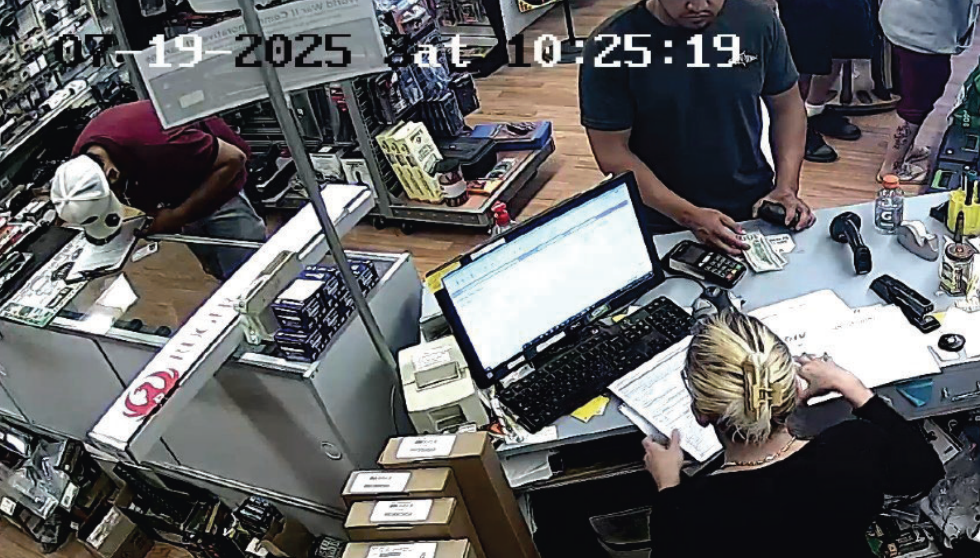
IV Guns did not turn Samuel Ortega away because of any of these red flags. However, the sales to Ortega were denied because the federal background system flagged him as prohibited. IV Guns did proceed with the sales to Santos, however.11Id.
On July 24, 2025, ATF agents returned to IV Guns and interviewed the employee in charge of maintaining the store’s records. According to court filings, the employee said that she was “familiar” with the purchasers but did not know how many guns they had purchased and “never asked the individuals why they were purchasing so many of the same firearms.”12Id. at 4-5. The employee further stated that she did not realize how many Beretta pistols the individuals had purchased until the store’s Beretta supplier advised her that they could not keep up with the volume of firearms being purchased by the trafficking ring and “would need more time to locate the models of firearm they consistently ordered.” There is no indication in the court records that the employee stopped selling to the individuals after that conversation. According to court filings, “Most of the time the four individuals would order more firearms when they were at the store picking up firearms they previously ordered.”13Id. at 5.
When ATF agents interviewed Santos after his arrest, he said that he sold the guns to anyone who would buy them, earning roughly $100 to $150 per firearm. He further claimed that IV Guns staff would fill in the box on his ATF paperwork certifying his U.S. citizenship.14Detention Memo at 2-3.
The Importance of Compliance Inspections
Months before the ATF flagged IV Guns, an ATF investigator inspecting another Oregon dealer identified another suspected trafficking operation: a gun store had sold at least 76 guns to a single buyer, Vincente Cortes Quiroz, who had purchased 124 firearms in Oregon since 2014.15Government’s Sentencing Memorandum, United States v. Cortes Quiroz, https://storage.courtlistener.com/recap/gov.uscourts.ord.192767/gov.uscourts.ord.192767.42.0.pdf.
That both of these large-scale trafficking operations were discovered through compliance inspections in Oregon underscores the importance of frequent, thorough inspections. Yet the Trump administration has spent the last two years hampering ATF inspectors’ ability to fulfill this role. In April 2025, the ATF repealed the zero-tolerance policy it had adopted in 2021 for revoking the licenses of dealers who willfully violate federal law. Two months later, the ATF ended the Demand Letter 2 program used to monitor gun dealers who sell the most crime guns. The agency also shed 135 inspectors between fiscal years 2024 and 2025, leading to 1,224 fewer inspections.
The erosion of the ATF’s inspection program reflects the Trump administration’s deliberate rollback of industry oversight. ATF Director Cekada recently told gun rights proponents that the ATF revoked just 12 dealer licenses in 2026 compared to the 90 revoked in 2025. He credited a new internal signoff process that requires “three or four additional layers” of review before a proposed revocation reaches his own desk for approval.
When a dealer, like IV Guns, does not prevent repeated sales to gun traffickers, an ATF inspector reading the same paperwork can still catch it during a compliance inspection. But that backstop is only as strong as the agency behind it, and the fewer inspectors ATF has, the fewer cases like this one ever get caught.
IV Guns Remains Open for Business
A federal grand jury indicted all four individuals in January 2026 for making false statements on their application to purchase firearms and for illegally possessing firearms.16Indictment, United States v. Santos, https://storage.courtlistener.com/recap/gov.uscourts.ord.191505/gov.uscourts.ord.191505.32.0.pdf. On August 3, 2026, Santos pleaded guilty.17Plea Agreement, United States v. Santos, https://storage.courtlistener.com/recap/gov.uscourts.ord.191505/gov.uscourts.ord.191505.80.0.pdf. He faces up to 15 years in prison and is scheduled to be sentenced on October 9, 2026.18U.S. Attorney’s Office, District of Oregon, “Mexican National Unlawfully Residing in the United States Pleads Guilty to Firearms Offenses,” August 6, 2026, https://www.justice.gov/usao-or/pr/mexican-national-unlawfully-residing-united-states-pleads-guilty-firearms-offenses. His three co-defendants’ cases remain pending.
IV Guns and Ammo has not been criminally charged, nor has the ATF revoked its license, and the store remains open in Cave Junction. Federal law requires dealers to refuse any sale they know, or have reasonable cause to believe, would be illegal, and both the ATF and the National Shooting Sports Foundation train dealers to recognize the exact pattern that played out at the store’s counter for more than a year: the same buyers using the same addresses to buy similar guns in bulk over a short period of time, largely paying in cash.