On July 2, 2026, the Bureau of Alcohol, Tobacco, Firearms and Explosives (ATF) issued a press release celebrating its “major enforcement wins” following its “2025 shift in priorities” under the Trump administration. The ATF noted that it had “refocus[ed] on violent crime, transnational criminal organizations, and illegal pipelines supplying them firearms.”
Many of the press release’s “wins” are tied to operations carried out with the Homeland Security Task Force, an interagency partnership created by the Trump administration and co-led by the Department of Homeland Security with several priorities, including removing “violent criminal aliens from the United States.” Trump’s immigration crackdown is once again facing public backlash after ICE personnel shot and killed 52-year-old Lorenzo Salgado Araujo in Houston, Texas, on July 7 and 26-year-old Joan Sebastian Guerrero in Biddeford, Maine, on July 13. According to reports, federal immigration agents have fired upon 22 people since January 2025 and killed six, including three U.S. citizens.1Allison McCann, “At Least 21 People Have Been Shot at by Federal Immigration Agents Since Last Year,” The New York Times, July 10, 2026, https://www.nytimes.com/2026/07/08/us/immigration-agent-shootings-vehicles.html. After this article was published, The New York Times updated its list of shootings to include Guerrero.
At the same time, the ATF’s press release serves as yet another example that the agency has turned away from one of its primary responsibilities — regulating and overseeing the gun industry — under Trump as part of its “New Era of Reform.”
The ATF CHANGES COURSE
According to the press release, “[s]ince January 2025, the ATF has focused on dismantling cartel and gang networks, arresting in the process over 10,000 offenders and seizing more than 49,000 firearms and roughly 2.9 million rounds of ammunition and 31,000 illegal explosives from them. The results come in part through the Homeland Security Task Force (HSTF) effort, where ATF works alongside FBI, DEA, HSI, and hundreds of state and local partners and is currently active in more than 1,200 HSTF investigations.”
These figures underscore reports from November alleging that the ATF had reassigned roughly 80 percent of its special agents, who are normally charged with investigating gun crimes and policing the gun industry, to carry out President Trump’s immigration priorities. Newly appointed ATF Director Robert Cekada has denied those reports, however. During his confirmation process, he said that only 75 to 100 special agents had been reassigned per day.2Robert Cekada, Responses to Questions for the Record, U.S. Senate Judiciary Committee, response to Question 1 from Senator Durbin, https://www.judiciary.senate.gov/imo/media/doc/3502d997-daa5-f550-7914-e7d18cc5b59b/2026-02-04_QFR-Responses_Cekada.pdf. More recently, before the House Oversight Committee, Cekada said that “not one person has been reassigned” to immigration enforcement and called the original reporting “completely wrong.”3C-SPAN, “ATF Director Testifies on Firearms Policy and Second Amendment Protections,” May 14, 2026, https://www.c-span.org/program/house-committee/atf-director-testifies-on-firearms-policy-and-second-amendment-protections/679182, at 1:22:30.
The press release also touts that the ATF referred 155-percent more cases to the Department of Justice for potential prosecution in 2025 compared to 2024, including those involving straw purchasing and gun trafficking. However, the ATF’s own records indicate that it can take several years to refer and complete trafficking investigations, meaning that referrals made in 2025 likely began during the previous administration.4ATF, National Firearms Commerce and Trafficking Assessment, Volume Four, “Part I: Introduction and Methodology,” January 8, 2025, 8, https://www.atf.gov/firearms/national-firearms-commerce-and-trafficking-assessment-nfcta-firearms-trafficking-investigations-volume-four.
ATF fact sheets also include information notably absent from the ATF press release: data on gun dealer inspections. In fiscal year 2025, the ATF inspected 8,472 gun dealers — 1,224 fewer than the year before — yet uncovered violations of federal gun law in 44 percent of them. One reason for the drop in inspections: The ATF shed 135 Industry Operations Investigators (IOIs) between fiscal years.
ENDANGERING THE PUBLIC
The ATF also used its press release to highlight a gun industry priority: speeding up the approval process for people to purchase machine guns, silencers (or sound suppressors), short-barreled rifles and shotguns, and other deadly weapons regulated by the National Firearms Act (NFA). The ATF states that it has “processed more NFA forms in calendar year 2026 than in all of 2025 and has significantly reduced processing times for key NFA forms since January 2025.” As an example, the ATF says it has reduced the application processing time for individuals interested in purchasing silencers and short-barreled firearms from 143 days to just eight days.
Since January — when Trump’s One Big Beautiful Bill Act removed the $200 taxes that had been required to make and purchase silencers and other NFA weapons since 1934 — the ATF has regularly updated its website to demonstrate its progress on NFA applications. In the first five months of this year, the ATF processed 1.28 million NFA forms, including over 700,000 to purchase silencers. The ATF states that Americans now own 6.4 million silencers as of June 1, a 2,159-percent increase from the roughly 285,000 owned nationwide in 2010.
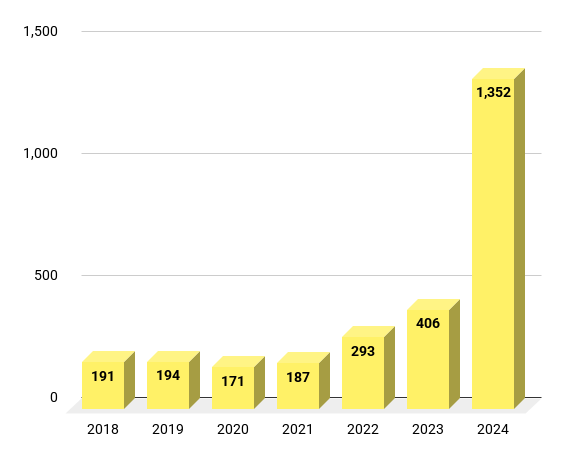
The ATF’s decision to prioritize speed over thoroughness may explain why one man successfully registered a potato as a silencer back in January. While the ATF press release brags about historically fast NFA approvals, it fails to mention what steps the agency is taking to protect the public from these dangerous devices. As discussed here, silencers make it difficult for bystanders and police to recognize that a gun has been fired and pinpoint the direction of fire. Predictably, the ATF’s own data is already beginning to show an uptick in silencers recovered from crime scenes.5ATF Firearms Trace Data, “Firearm Types Recovered and Traced in the United States and Territories,” 2018-2024.
Silencers recovered by law enforcement
Despite this, the ATF is moving forward with several proposals designed to make it easier for people to purchase and own NFA weapons, and even cross state lines with them, among other regulatory rollbacks that would help the gun industry and damage public safety. Most recently, on July 6, the ATF published another proposal in the Federal Register that would allow NFA applicants to submit copies of their photo IDs instead of passport-style photos, and that removes fingerprint requirements for people added to trusts for collective ownership of NFA weapons.