For years, Sig Sauer has fiercely defended its P320 against allegations that the pistol can fire without an intentional trigger pull. As lawsuits accumulated and some law enforcement agencies moved away from the handgun, Sig Sauer maintained that the P320 is safe and that reported incidents do not demonstrate a defect in the pistol. On its website, the company states that “as designed, the P320 cannot, under any circumstances, discharge without a trigger pull,” pointing to internal safeties, government testing, and favorable court decisions as evidence supporting that position.
But on September 22, Sig Sauer introduced the P385, a new pistol that the company says was “developed from the ground up.” Yet it occupies much of the same territory as the P320. For example, both guns are striker-fired, 9mm designs that use the same magazines and feature removable fire control units, meaning customers can install different slide assemblies and grips to adjust the gun’s overall size. The most notable change, however, is a new passive trigger safety that the standard P320 does not have.
The new mechanism — what Sig Sauer calls the “Trigger Block” — is incorporated into the face of the trigger. Unlike the protruding trigger safety blades found on many competing striker-fired pistols, the P385’s Trigger Block sits flush with the trigger face and must be depressed before the trigger can move rearward. Sig Sauer describes the mechanism as providing a “redundant drop safety” feature. The design marks a notable departure from the standard P320 and P365, neither of which has a comparable trigger safety.
Gun Industry Reactions
Many gun industry publications familiar with years of controversy over the P320 were quick to point out the new addition. Guns.com called the Trigger Block one of the P385’s most notable features, writing that “a lot of folks are hesitant to carry Sig Sauer handguns due to issues reported on the P320, so the addition of the trigger safety will be a welcome feature.” AmmoLand similarly called the Trigger Block a “notable departure” from the P320 and P365, and said the new design “deserves scrutiny on its own terms, especially from owners who have followed the debate over the P320.”
AmmoLand also noted that Sig Sauer did not “provide a mechanical diagram or establish how this design performs in independent safety testing,” a caveat quite uncharacteristic for new gun announcements.
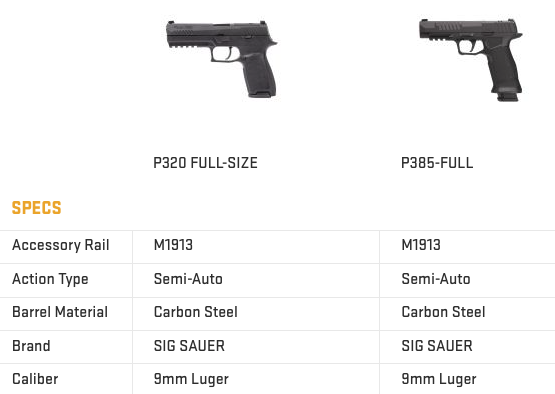
Other industry publications questioned where the P385 leaves the P320. For example, Gun Digest described the P385 as arriving “after the success and controversy of the P320” and said the new pistol “seems to be replacing the P320, at least in spirit.” Another site, Gun Talk, said the new pistol “fixes the friction points shooters have had with both” the P320 and P365 and provided a simple formula: “P320 plus P365 equals P385.”
Perhaps the most pointed reaction came from the military and firearms publication We Are The Mighty, which published an article with the headline “The P320 is so safe and reliable that Sig Sauer released the P385.” The publication noted that Sig Sauer had previously omitted the type of trigger safety found on Glock and Smith & Wesson pistols from the P320, deeming it unnecessary. Against that history, the outlet called the P385’s new Trigger Block “an interesting change in tune” and concluded that the new handgun “appears to fill a nonexistent gap still occupied by the P320.”
Shooting News Weekly was even more direct, arguing that despite Sig Sauer’s insistence that the P320 will remain part of its lineup, the pistol “isn’t long for this world.” The publication argued that Sig Sauer “never would have created an entirely new pistol platform if they saw any viable future for the P320 aside from military sales,” and pointed specifically to the P385’s new “redundant drop safety mechanism” as a feature the company “probably wish[es] they’d included in the P320 back in 2014.” The outlet also reiterated its previous conclusion that, regardless of whether the P320 is actually capable of firing without an intentional trigger pull, the pistol’s reputation may be “too damaged to be saved as a viable commercial product.”
Sig Sauer’s Messaging
Sig Sauer appears to have anticipated exactly this interpretation that the release of a new model was a tacit acknowledgement that the P320 is defective. On an FAQ page, the company answers the question “Did Sig Sauer launch the P385 because of the perceived issues with P320?” with “No.” According to Sig Sauer, the P385 “has been in development for years” and is part of the company’s effort to “continuously innovate and develop new products for an evolving market.” The company also says that the P320 remains an important product family and will continue to be sold and supported, also noting that there are no plans “at this time” to bring the Trigger Block to the P320.
But the P385 creates a difficult comparison for Sig Sauer nonetheless. While maintaining that the P320 is safe to own, the company has debuted another modular, striker-fired 9mm pistol that has an additional mechanical safeguard against unintended trigger movement. Even publications and shooters otherwise friendly to Sig Sauer have immediately noticed the contrast.
The P385 is not by any means proof that Sig Sauer believes the P320 is defective, and the Trigger Block cannot necessarily prevent every type of malfunction alleged in P320 lawsuits. But after years of Sig Sauer insisting the P320 does not need the type of trigger-mounted safety used by many competing striker-fired pistols, the decision to put one in its newest platform leaves a straightforward question hanging over the launch: If the P320’s existing safeguards are already sufficient, what problem was the P385’s new Trigger Block designed to solve?