On October 16, 2025, the state of New Jersey filed a lawsuit against Sig Sauer for marketing its flagship P320 pistols as being safe and trusted by military and law enforcement personnel despite allegedly knowing for years that the guns can fire without an intentional trigger pull.
According to the complaint, “Throughout New Jersey, and across the country, Sig Sauer P320s have fired when their users did not want them to, with gruesome regularity. The victims include local, state, and federal law enforcement, combat veterans, firearms instructors, and a wide range of civilian gun owners.” Yet Sig Sauer “assur[ed] consumers that the…P320 could not unintentionally fire during ordinary, responsible use and handling.”
The filing — which seeks several remedies, including a statewide recall — is the latest in a string of lawsuits regarding the P320, and comes after The Smoking Gun published court documents showing that Sig Sauer had been aware of the P320’s risks as far back as 2017. In recent years, multiple law enforcement agencies have also pulled the P320 from duty due to safety concerns, including police departments in Chicago, Dallas, Denver, Houston, and most recently, Hawaii.
A CLOSER LOOK AT THE LAWSUIT
The complaint describes the P320 as “a set mousetrap,” as a “loaded P320 is always fully ‘cocked,’ meaning that once a round is in the chamber, the weapon is ready to fire because the firing mechanism has sufficient potential energy to initiate a discharge.” The system, it continues, “depends on the precise positioning and quality of movable parts subject to wear and tear. Far too often, under normal use, the P320 striker unintentionally releases…firing the gun.”
The results have been fatal. The complaint details nine incidents in which New Jersey police officers were wounded by their P320s and another where a detective lieutenant of the Orange Police Department was killed by his P320 when it discharged as he prepared to clean it.
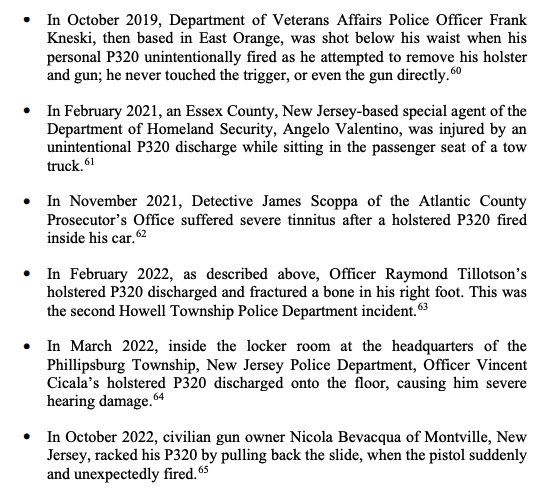
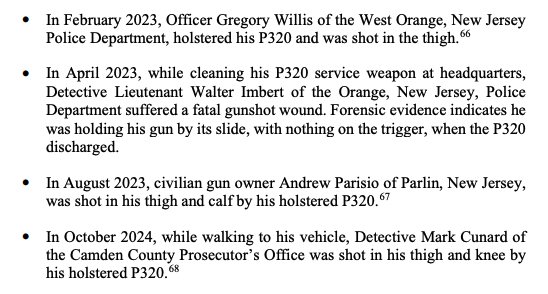
In addition to discussing similar shootings that have occurred across the U.S., the complaint dives into Sig Sauer’s “unreasonable and deceptive marketing” tactics, noting that when the P320 was first launched, the company described it as “the most operator-safety focused striker duty pistol on the market today,” and that it “provides an enhanced level of safety not found on most modern service pistols,” despite the fact that the vast majority of P320s sold to civilians and police do not feature external safeties.
According to the complaint, Sig Sauer claimed that “the P320 provided ‘an enhanced level of safety’ through its internal restraints,” but “for years…has known that the P320’s internal ‘safeties’ do not prevent the guns from firing when the user does not want them to fire.” As an example, the complaint points to the U.S. Army “requir[ing] Sig Sauer to add a manual thumb safety feature for the variants of the P320 it procured, known as the M17 and M18,” after finding that the gun discharged during drop testing and “posed an unacceptable danger of firing when the user did not want it to fire.”
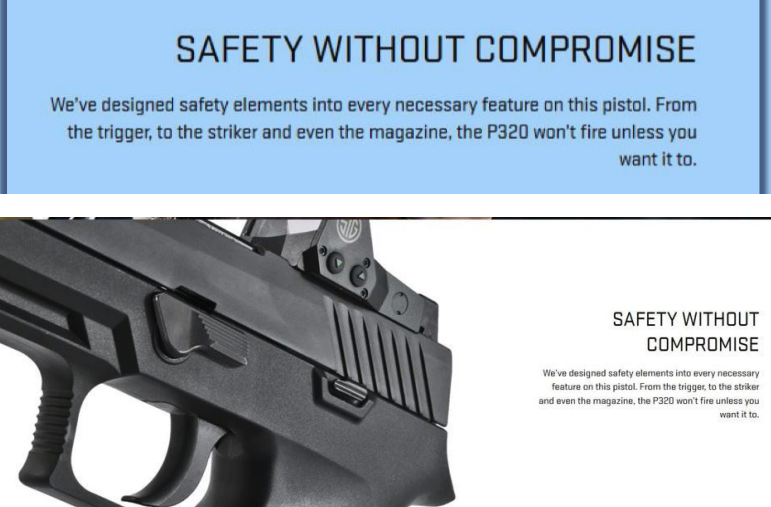
Instead of changing course “[i]n response to the mounting injuries and lawsuits,” the complaint notes that “Sig Sauer has made a series of public statements designed to assure customers and users that there was no risk of the P320 firing when the user did not want it to fire,” asserting that “it is not possible for the P320 to discharge unless the trigger is fully actuated.”
Such statements, the complaint alleges, “mislead or deceive reasonable consumers into falsely believing that anything short of a ‘full’ pull of the trigger would not and could not result in the gun firing. But that, too, was contradicted by the experience of numerous Sig Sauer customers, both law enforcement and civilian, in New Jersey and across the Nation, of which Sig Sauer had knowledge.”
Ultimately, New Jersey’s lawsuit calls the P320 “a threat to the New Jersey police officers, veterans, and everyday individuals who use and rely upon the gun” and seeks “an order enjoining Sig Sauer from continuing to distribute its defective P320s in New Jersey and to cease its unreasonable and deceptive marketing.”
Sig Sauer’s Response
After the lawsuit was announced, Sig Sauer quickly issued a statement calling the “baseless complaint” an “attack” on not just the company, but the “firearms industry” as a whole. The company also said the “P320 pistol is one of the safest, most advanced pistols in the world,” claiming it “meets and exceeds all industry safety standards.”
Instead of addressing the numerous law enforcement agencies that have stopped using the P320, or even videos that appear to show the pistols firing without intentional trigger pulls, Sig Sauer stated that the “design has been thoroughly tested and validated by the U.S. Military and law enforcement agencies at the federal, state and local levels, along with several major global militaries.”
New Jersey may be the first state to sue Sig Sauer over the P320, but the allegations trace a familiar pattern that’s been unfolding for years in courtrooms and police departments across the country.