Guns have been the leading cause of death for children and teens since 2020. But the Bureau of Alcohol, Tobacco, Firearms and Explosives (ATF) is proposing to eliminate a longstanding federal requirement that gun dealers provide customers with written warnings created to help prevent children and teenagers from illegally accessing handguns and hurting themselves or others.
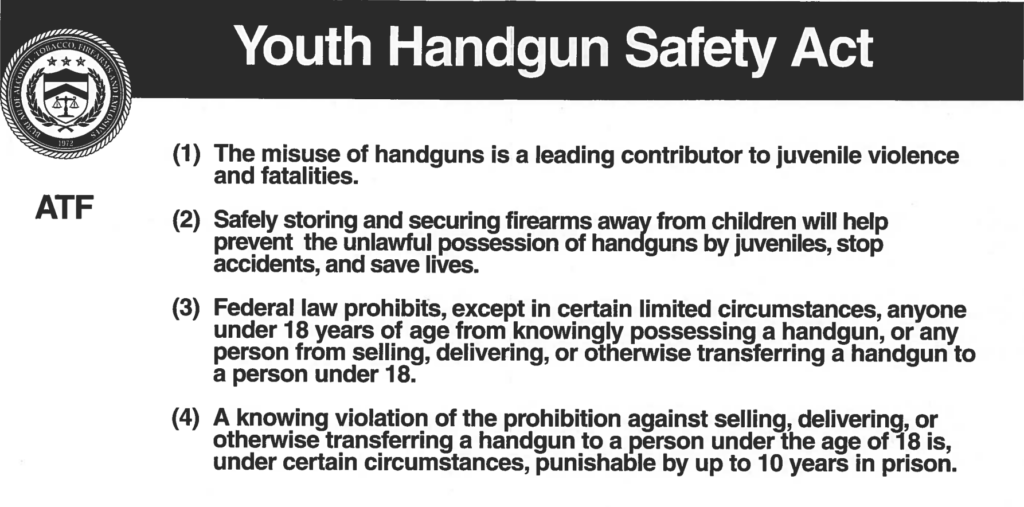
If the ATF’s proposed rule is finalized, federally licensed gun dealers would no longer need to post Youth Handgun Safety Act notices in their stores or provide pamphlets to handgun purchasers explaining that federal law generally prohibits transferring handguns or handgun ammunition to juveniles.
The proposal is one of many that the ATF announced in late April. As discussed here, the rules reflect that under President Trump, the agency is more interested in deregulating the gun industry than protecting the public
Undermining the Youth Handgun Safety Act
Passed as part of the 1994 crime bill, the Youth Handgun Safety Act generally prohibits anyone under the age of 18 from knowingly possessing a handgun and bars anyone from selling or transferring a handgun to anyone under 18.
In 1998, following a Clinton administration directive aimed at reducing youth handgun violence, the ATF issued a rule requiring that gun dealers post a sign warning customers of the Youth Handgun Safety Act’s provisions as well as written notification with each handgun sold — often a pamphlet tucked inside the gun’s case. Additionally, the notices warn gun buyers that “the misuse of handguns is a leading contributor to juvenile violence and fatalities,” and that “safely storing and securing firearms away from children will help prevent the unlawful possession of handguns by juveniles, stop accidents, and save lives.”
the atf’s about-face
Despite the danger firearms continue to pose to children and teens, the ATF argues in its proposed rule that gun dealers should no longer be required to provide customers with Youth Handgun Safety Act notices because the law is “well-established, and FFLs and the public are aware of its requirements.” The ATF also claims that information about the law is widely available online, making the notices “redundant,” and that gun dealers are informed about the law during the licensing process.
But eliminating the rule would remove the only point-of-sale notices specifically warning customers about youth handgun restrictions and the consequences of transferring firearms to minors.
The ATF now characterizes the warnings as an “unnecessary” administrative “burden” on gun dealers. According to the agency’s economic analysis, the average dealer spends just $16 annually complying with the requirement, while the firearms industry as a whole would save an estimated $794,272 annually, or $8 million over 10 years, if the rule is rescinded. The agency calculated those savings largely by estimating the cost of printing black-and-white paper notices at roughly three cents per page.
Oddly enough, shortly before announcing the proposed rule, the ATF itself published an updated version of the Youth Handgun Safety Act pamphlet in March 2026.
Fewer Warnings for Gun Buyers
As mentioned, the proposal is part of a broader deregulatory push within the ATF and the Trump administration aimed at rolling back firearm regulations viewed as burdensome to the gun industry. In the proposed rule, the ATF states that it is “seeking ways to reduce the administrative hurdles that would inhibit growth for small businesses” — something far outside of the agency’s traditional roles of enforcing federal gun laws like the Youth Handgun Safety Act and ensuring that the gun industry follows them.
Although the proposed rule would not change the underlying federal prohibition on transferring handguns to juveniles, it would eliminate the only federal safety notices given to handgun buyers regarding youth access to firearms. As the ATF notes, the rule carries “the risk that the public might not be informed of existing requirements not to deliver or transfer firearms to juveniles.”
In short, the move will end a long-running public awareness campaign aimed at saving lives, all to save gun dealers $16 per year.