Just four days after a shooting at the White House Correspondents’ Dinner with President Trump in attendance, the Department of Justice and Bureau of Alcohol, Tobacco, Firearms and Explosives (ATF) announced that they intended to implement a raft of changes to to the country’s gun regulations. The ATF has only released summaries of the rules so far, but like past deregulation efforts by the Trump administration, many will likely put public safety at risk and hamper law enforcement efforts to solve gun crimes and stop traffickers.
That hasn’t stopped the administration from claiming that the changes are simply “an effort to reduce unnecessary burdens on law-abiding citizens and businesses” and “do not compromise ATF’s ability to perform its critical missions to protect American communities from violent crime.”
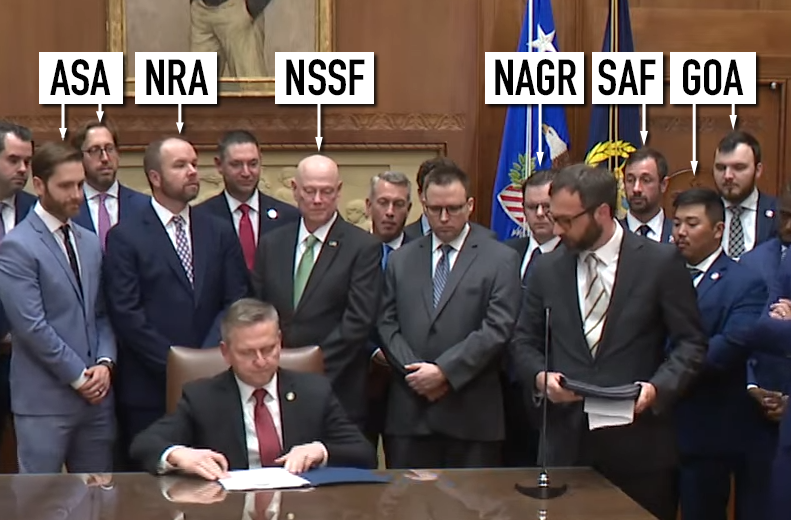
However, as discussed below, the rules are clearly designed to benefit the gun industry, whose surrogates were all in attendance at the press conference announcing the rules — including some representing extreme groups dedicated to undoing all gun laws. Leaders from the American Suppressor Association (ASA), National Rifle Association (NRA), National Shooting Sports Foundation (NSSF), National Association for Gun Rights (NAGR), Second Amendment Foundation (SAF), and Gun Owners of America (GOA) surrounded Robert Cekada, the ATF’s new director, as he signed the rules.
A Closer look at the ATF rules
At the press conference announcing the rules, Cekada said that the DOJ and ATF “did, and always will, take public safety into account when creating proposals,” and promised that he would “never let the public be at risk based on the regulations that we are proposing today.”1The Justice Department, “Press Conference,” YouTube, April 29, 2026, https://www.youtube.com/watch?v=aQ5PywCy1xU&t=1987s, at 46:32.
Yet several of the proposed and final rules will make it easier for guns to fall into the hands of people who are legally prohibited from having them, including those with felony convictions and domestic abusers. For example, during the press conference, Cekada said that the ATF will rescind the “Engaged in the Business” rule cracking down on unlicensed gun sellers,2Ibid, at 47:30. which the ATF itself identified as the top sources of firearms for gun traffickers, representing 41 percent of trafficking investigations between 2017 and 2021.
That rule simply helped implement the Bipartisan Safer Communities Act, enacted in 2022, which updated the longstanding statutory standard for which gun sellers need to obtain a dealer license and, in turn, keep sales and inventory records, conduct background checks on customers, and meet additional requirements under federal law. But gun groups railed against the rule since it was first proposed in September 2023, calling it a “backdoor scheme” to require background checks on all gun sales. The NSSF even claimed it “create[d] criminal law through executive fiat.”
Pushing Guns Into the Wrong Hands
Another ATF proposal would make it easier for gun dealers to sell guns to buyers who reside in the same state but do not appear in person to complete the sale, in what’s known as a “non-over-the-counter” (NOTC) transaction. The rule could allow gun dealers to simply mail guns to people’s doors, removing the need to visit a brick-and-mortar store — and creating a new gun trafficking channel. The system is already in use with silencers, and the U.S. Postal Service recently proposed a rule to undo the 99-year-old ban on mailing handguns in response to a memorandum opinion issued by the DOJ that declared that same ban to be unconstitutional.
The ATF also says that it is revising ATF Form 4473, the transaction record required for all commercial firearm transfers, to “streamline identity and residency verification requirements for transferees.” With the current form, a potential transferee must affirm that they can legally possess a firearm by answering several yes or no questions before the background check is administered. But a shorter or simplified version that skips these questions may make it harder to prove that the buyer is illegally straw-purchasing the gun for someone else, for example — and provide cover for gun dealers who complete the sales.
That is a common theme with the proposals. Gun dealers who willfully violate federal gun laws can have their licenses revoked, but the ATF states that it will soon redefine “willfully” to only apply in situations where gun dealers “know their conduct is unlawful” — something that will be difficult for investigators to prove. In the past, the ATF considered repeat violations “willful,” for example. Another ATF proposal will also detail “which transactions are not considered straw purchases.”
Currently, gun dealers must retain their sales and inventory as long as they are in business so law enforcement can trace crime guns and solve cases, but another ATF proposal would allow gun dealers to destroy those records after “20 or 30 years” — destroying any chance law enforcement has of tracing older guns. It would also require the ATF to destroy the records of dealers who go out of business after as many years and multiple sales reports, which are used to identify straw purchasers making bulk purchases, after five years.
Together, these proposals hinder law enforcement. But at the press conference announcing the rules, Acting U.S. Attorney General Todd Blanche said the opposite: “Nothing we are doing today weakens law enforcement. We are not taking tools away from the people, the men and women who go after violent criminals.”3Ibid, at 40:47.
Opening the Floodgates for Deadlier Weapons
The ATF also announced that it would rescind its “arm brace” rule, which was finalized in 2023 to stop gun makers from selling easily concealed short-barreled AR-15s, AK-47s, and other assault weapons as “pistols” — instead of short-barreled rifles that must be registered under the National Firearms Act (NFA) — when fitted with arm braces that look and can operate like shoulder stocks. Such guns have been used in at least five mass shootings, including in Boulder, Dayton, Colorado Springs, Nashville, and Manhattan.
But last year, less than a week before the July 2025 mass shooting in Manhattan, the Trump administration signaled that it would stop defending the arm brace rule in court.
Another ATF proposal would carry out the agency’s earlier decision to end the requirement for NFA applicants — those seeking to make or purchase silencers, short-barreled rifles and shotguns, and other deadly NFA weapons — to notify the chief law enforcement officer in their area as part of their application. Without this measure, local law enforcement won’t know who in their jurisdictions has such dangerous weapons, nor will they be able to provide the federal government with additional information about public safety concerns that might stop the application from moving forward.
Under another proposal, the owners of NFA weapons will no longer need the ATF’s approval to cross state lines with the items, and those doing so in the “short term” — within 365 days — will no longer need to even notify the agency beforehand.
Finally, several proposals appear to be a windfall for gun importers. Two separate ATF proposals would allow importers to manufacture and sell firearms from customs bonded warehouses, and more easily convert temporary imports into permanent ones. And the Gun Control Act establishes that gun makers can only import firearms useful for “sporting purposes” (i.e., hunting and traditional competitive shooting), but one ATF proposal would allow gun companies to import “dual-use” gun parts — barrels, frames, and receivers — that are used to build more tactically oriented firearms as long as they could also be used for sporting purposes. In other words, the proposal could make it easier for companies to import the building blocks used to make assault weapons.
The Smoking Gun will have more on the proposed and final rules as they are published.