When Joly Germine, the imprisoned leader of Haiti’s 400 Mawozo gang, needed military-grade weapons, his network went shopping at Orlando-area gun stores. Between September 28 and October 17, 2021, one associate, Jocelyn Dor, walked into Rieg’s Gun Shop, The Shooting Gallery Range, Shooter’s World, and Shoot Straight, all in Orlando, and walked out with 10 high-powered weapons.1Government’s Memorandum in Aid of Sentencing, United States v. Dor, No. 21-cr-699-3-JDB (D.D.C. Feb. 21, 2024), at 3-9, https://storage.courtlistener.com/recap/gov.uscourts.dcd.238008/gov.uscourts.dcd.238008.165.0.pdf; Trial Transcript, United States v. Germine, No. 1:21-cr-699-JDB (D.D.C. Jan. 23, 2024), testimony of ATF SSA Jaime Morales at 56, https://storage.courtlistener.com/recap/gov.uscourts.dcd.238008/gov.uscourts.dcd.238008.185.0.pdf.
These firearms included a .50-caliber Barrett M82A1 rifle that Dor bought at Shooter’s World for just under $11,000, and a Springfield Armory M1A rifle from the same store. At Shoot Straight, he bought two AK-style rifles one week — a Riley Defense RAK-47 and a Century Arms VSKA — and two more VSKAs the following week. At Rieg’s Gun Shop and The Shooting Gallery Range, he bought VSKAs on consecutive days along with boxes of ammunition.2Government’s Memorandum in Aid of Sentencing, United States v. Dor, at 3-9, https://storage.courtlistener.com/recap/gov.uscourts.dcd.238008/gov.uscourts.dcd.238008.165.0.pdf. At Germine’s trial in 2024, an ATF agent testified that the rifles were intended for “combat” and that the Barrett .50-caliber rifle is used by “many militaries” to disable enemy equipment. The agent said that the latter is so powerful it’s “against the Geneva Convention to use this against a human being.”3Trial Transcript, United States v. Germine, at 55-60, https://storage.courtlistener.com/recap/gov.uscourts.dcd.238008/gov.uscourts.dcd.238008.185.0.pdf.
The red flags in these sales were hard to miss. As discussed below, Dor recorded audio messages and sent pictures to his co-defendant, Eliande Tunis, during the transactions, and at least one clerk was suspicious enough to ask directly whether he was buying guns for someone else. But the clerk made the sale anyway.4Government’s Memorandum in Aid of Sentencing, United States v. Dor, at 3-10, https://storage.courtlistener.com/recap/gov.uscourts.dcd.238008/gov.uscourts.dcd.238008.165.0.pdf.
Meanwhile, in Haiti, the 400 Mawozo gang had kidnapped 16 American citizens and one Canadian, including five children, with one as young as eight months old. The gang held the group hostage and demanded a ransom of $1 million per head.
This case is just one example of the gun trafficking pipeline that stretches from Florida gun counters to crime scenes across the Caribbean. As law enforcement data and federal prosecutions have made clear, this pipeline is fueling gun violence across the region.
Editor’s Note: This is the second installment of The Smoking Gun’s “Trafficking Spotlight” series following the trail from gun shop to crime scene. Read our first installment here.
The iron pipeline from florida
The Caribbean is a region with no gun manufacturers, yet gun violence has reached historic levels. The aggregate homicide rate across the region has more than doubled since 2016, reaching a record high in 2023 and 2024, and firearms were involved in 86 percent of all homicides reported by Caribbean Community (CARICOM) member states in that time period.
The guns driving this violence are overwhelmingly American, and overwhelmingly Floridian. According to the Government Accountability Office, 73 percent of the 7,399 crime guns recovered from 25 Caribbean countries and traced by the Bureau of Alcohol, Tobacco, Firearms and Explosives (ATF) between 2018 and 2022 originated in the United States. An ATF report also notes that over half of the weapons recovered and traced in the Caribbean between 2017 and 2021 were originally purchased from federally licensed gun dealers in Florida. South Florida alone, including the ports of Miami and Fort Lauderdale, was the point of origin for nearly 90 percent of seized Caribbean-bound shipments of illicit firearms reported between 2016 and 2023.
Officials from the region, which has less than 1 percent of the world’s population and nearly a quarter of its recorded homicides, have identified the problem in stark terms:
- The Bahamas: Bahamian law enforcement officials have stated that 90 percent of firearms recovered and submitted for tracing were purchased in the United States, citing “a lax Florida marketplace for gun sales” as a part of the problem. According to the officials, in some cases, guns sold in the U.S. have been used in the commission of violent crime in the Bahamas within 24 hours. In 2023, Prime Minister Philip Davis led a coalition of Caribbean states in filing an amicus brief in a U.S. appellate court arguing that the “[u]nlawful trafficking of American firearms must be curtailed at its source: the U.S. gun industry. The gun manufacturers and distributors from a single nation must not be permitted to hold hostage the law-abiding citizens of an entire region of the world.”
- Dominican Republic: The Dominican Republic serves as both a destination and a transit corridor for firearms bound for Haiti. In 2024, 95 percent of crime guns recovered there and traced by the ATF originated from the U.S. In February 2025, Dominican customs agents made what they described as the country’s largest-ever weapons seizure destined for Haiti: nearly two dozen firearms, including a Barrett .50-caliber rifle and 15 AK-style rifles, along with 36,000 rounds of ammunition, concealed in a container shipped from Miami.
- Haiti: The United Nations estimates between 270,000 and 500,000 illegal weapons are circulating in Haiti, which has been under a UN arms embargo since 2022. One UN report found that the “principal source of firearms and munitions in Haiti is in the US, and in particular Florida. Popular handguns selling for $400-500 at federally licensed firearms outlets or private gun shows in the US can be resold for as much as $10,000 in Haiti.”
- Jamaica: Jamaican officials have estimated that 200 guns per month are trafficked from the U.S. by criminal gangs and have identified Florida as a significant source of illicit firearms.
Perhaps the starkest illustration of the pipeline’s impact is in Puerto Rico. From January 2014 to August 2019, every single out-of-state gun used in a crime there was sold by a Florida dealer.
a closer look at three trafficking operations
Three examples highlight the trafficking problem:
Arming Haitian Gangs
When Jocelyn Dor walked into those four Orlando stores between late September and mid-October 2021, he was acting on behalf of an operation directed from a Haitian prison cell. Dor was buying for 400 Mawozo, the Haitian gang holding 16 American citizens and one Canadian, including five children, hostage outside Port-au-Prince.
On October 4, Germine placed an 86-minute call to Tunis from his Haitian prison cell that included a 46-minute three-way leg with Dor — a nearly identical pattern repeated on October 17, the same day Dor bought two more VSKAs at Shoot Straight.5Government’s Memorandum in Aid of Sentencing, United States v. Dor, at 3-9, https://storage.courtlistener.com/recap/gov.uscourts.dcd.238008/gov.uscourts.dcd.238008.165.0.pdf.
In court filings, Dor’s WhatsApp chats illustrate what was happening while he stood at the gun shop counter. Tunis, his co-defendant, was on the phone, coaching him in real time to “[a]sk him how much” and “[h]ave them dismantle them for you.” Dor himself understood what the clerks were seeing. In an October 5 voice memo to Tunis, he said, “[T]ext me instead, darling. He keeps asking me if I’m buying them for someone else…he’ll be suspicious when I am on the phone.” According to the defendant, the clerk “was asking him questions about who he worked for, if his wife knew that he was buying these weapons and who he was buying them for.” Nonetheless, the store made the sale.6Id, at 10.
The National Shooting Sports Foundation, the gun industry’s own trade association, trains dealers to look for buyers who are nervous or evasive, who make bulk purchases of identical firearms, who have no purchase history but suddenly become frequent buyers, who bring large amounts of cash, who talk on the phone while looking at firearms, and who take or send photographs of guns to unknown recipients. Dor checked many of these boxes. At Shooter’s World, he bought two identical Century Arms VSKAs in a single visit, then returned five days later to buy the $11,000 Barrett rifle and Springfield M1A rifle. At Shoot Straight, he bought four VSKAs across two visits that were 12 days apart. He paid using cash that had, in some cases, arrived by wire transfer from Haiti hours earlier. He was on the phone during the transactions, sending images of rifles and voice notes to his conspirators.7Id.
The weapons were intended to be smuggled to Haiti wrapped in garbage bags, packed into blue plastic multi-gallon drums, and covered with clothes, shoes, and Gatorade to disguise the contents. None of the 10 rifles Dor purchased actually reached Haiti; the FBI intercepted the operation before shipment.
Ultimately, Dor received a 60-month sentence. Dor’s co-defendant, Walder St. Louis, who purchased firearms from Lucky Pawn & Jewelry in Miami on four separate occasions, received three years. Across the conspiracy, dozens of firearms and hundreds of rounds of ammunition were exported or attempted to be trafficked to Haitian gangs.
From Central Florida to the Bahamas
In January 2022, ATF agents received information that three firearms recovered at crime scenes in the Bahamas had been purchased by a Kissimmee man named Kingsley Wilson from licensed gun dealers in the Orlando area. During the course of the investigation, agents discovered a straw-purchasing operation that ran for a year and a half across six licensed gun stores in central Florida.8Affidavit in Support of a Criminal Complaint, United States v. Wilson, No. 5:23-cr-81-JA-PRL, Aug. 4, 2023, https://storage.courtlistener.com/recap/gov.uscourts.flmd.417609/gov.uscourts.flmd.417609.1.0.pdf. One dealer, Uber Pawn and Jewelry, accounted for more of the scheme’s documented volume than any other.9Indictment, United States v. Wilson, Aug. 22, 2023, https://storage.courtlistener.com/recap/gov.uscourts.flmd.417611/gov.uscourts.flmd.417611.24.0.pdf; Plea Agreement and Factual Basis, United States v. Wilson, Nov. 15, 2023, https://storage.courtlistener.com/recap/gov.uscourts.flmd.417609/gov.uscourts.flmd.417609.64.0.pdf; Plea Agreement and Factual Basis, United States v. Rodriguez, No. 5:23-cr-81-JA-PRL (M.D. Fla. Nov. 21, 2023), https://storage.courtlistener.com/recap/gov.uscourts.flmd.417609/gov.uscourts.flmd.417609.75.0.pdf.
Between January 2022 and July 2023, Wilson purchased 92 firearms from licensed dealers, including 49 that were purchased in 16 multiple-sale transactions. According to law enforcement, Wilson spent approximately $28,000 on firearms during this period.10Id, at 16. Many of the guns were of the same model, make, and caliber, including at least fifty-one 9mm handguns.11Id, at 12-13; 24-25. His girlfriend, Viviana Rodriguez, purchased another 48 guns. A federal grand jury charged the pair over 54 of those purchases.12Indictment, United States v. Wilson, Aug. 22, 2023, https://storage.courtlistener.com/recap/gov.uscourts.flmd.417611/gov.uscourts.flmd.417611.24.0.pdf. More than half of the charged firearms were traced to Uber Pawn, where several red flags were documented by the store’s own employees.13Id; Plea Agreement and Factual Basis, United States v. Wilson, https://storage.courtlistener.com/recap/gov.uscourts.flmd.417609/gov.uscourts.flmd.417609.64.0.pdf; Plea Agreement and Factual Basis, United States v. Rodriguez, https://storage.courtlistener.com/recap/gov.uscourts.flmd.417609/gov.uscourts.flmd.417609.75.0.pdf.
On April 16, 2022, Wilson bought two Smith & Wesson and three Taurus pistols in a single visit to Uber Pawn.14Plea Agreement and Factual Basis, United States v. Wilson, at 20, https://storage.courtlistener.com/recap/gov.uscourts.flmd.417609/gov.uscourts.flmd.417609.64.0.pdf. Six weeks later, on May 27, Rodriguez walked into the same store, and bought four HS Produkt pistols and two Glocks — six handguns in a single transaction.15Plea Agreement and Factual Basis, United States v. Rodriguez, at 21-22, https://storage.courtlistener.com/recap/gov.uscourts.flmd.417609/gov.uscourts.flmd.417609.75.0.pdf. The clerk asked her why she needed so many. Rodriguez told him she was “adding to her collection.”16Id. The clerk documented the exchange on the firearm transaction record and completed the sale. Two of those HS Produkt firearms were recovered at a crime scene 186 days later, and with that recovery came an ATF trace request to Uber Pawn identifying the store as the source dealer.17Id.
By that point, Uber Pawn had already done more business with Rodriguez. On June 25, 2022, she returned to the same store and purchased seven handguns in one transaction: three Glocks, two Tauruses, and two more HS Produkts. The clerk again asked her about the volume. This time Rodriguez said she was “building an armory.” The clerk documented the response once again on the transaction record and completed the sale. One of the Tauruses from that transaction was recovered in the Bahamas 49 days later. Two of the Glocks were recovered in Canada 87 days after that. Each recovery generated a trace request that landed back at Uber Pawn.18Id, at 22-23.
Three weeks after the June 25 purchase, Wilson came in and bought two Taurus pistols.19Plea Agreement and Factual Basis, United States v. Wilson, at 22, https://storage.courtlistener.com/recap/gov.uscourts.flmd.417609/gov.uscourts.flmd.417609.64.0.pdf. The following week, he returned for three Glocks.20Id, at 22-23. On October 31, Wilson bought four more firearms from another dealer, 4 Corners Pawn; one of them was recovered in the Bahamas 63 days later.21Id, at 23-24. Two days after that, on November 2, Wilson and Rodriguez returned to Uber Pawn and bought five more handguns across two separate transactions on the same day.22Plea Agreement and Factual Basis, United States v. Wilson, at 23, https://storage.courtlistener.com/recap/gov.uscourts.flmd.417609/gov.uscourts.flmd.417609.64.0.pdf; Plea Agreement and Factual Basis, United States v. Rodriguez, at 23, https://storage.courtlistener.com/recap/gov.uscourts.flmd.417609/gov.uscourts.flmd.417609.75.0.pdf. The clerk questioned Rodriguez about her purchase again; she said she was “just collecting.” The note was recorded, and the sale went through.23Plea Agreement and Factual Basis, United States v. Rodriguez, at 21-23, https://storage.courtlistener.com/recap/gov.uscourts.flmd.417609/gov.uscourts.flmd.417609.75.0.pdf.
By November 2, at least three firearms previously sold by Uber Pawn to Rodriguez had already been recovered at crime scenes in the Bahamas and Canada, and at least three ATF trace requests had been routed back to the store naming it as the source. Yet Uber Pawn sold them five more guns that day. It was the store’s seventh transaction with the pair in about six months.24Id; Plea Agreement and Factual Basis, United States v. Wilson, at 23, https://storage.courtlistener.com/recap/gov.uscourts.flmd.417609/gov.uscourts.flmd.417609.64.0.pdf; Indictment, United States v. Wilson, at 9-12, https://storage.courtlistener.com/recap/gov.uscourts.flmd.417611/gov.uscourts.flmd.417611.24.0.pdf.
By the end of the month, Wilson had begun working his way through the other dealers in the area: Florida Shore Firearms for three Glocks on November 26, Queen of Pawns and Jewellery for three more Glocks the same day and four more the following morning.25Plea Agreement and Factual Basis, United States v. Wilson, at 25-26, https://storage.courtlistener.com/recap/gov.uscourts.flmd.417609/gov.uscourts.flmd.417609.64.0.pdf. In 2023, five of the pair’s transactions occurred at Addison’s Gun Shop.26Id, at 27-29; Plea Agreement and Factual Basis, United States v. Rodriguez, at 27-29, https://storage.courtlistener.com/recap/gov.uscourts.flmd.417609/gov.uscourts.flmd.417609.75.0.pdf. At least some of these purchases were paid for in cash.27Affidavit in Support of a Criminal Complaint, United States v. Wilson, at 20-22, https://storage.courtlistener.com/recap/gov.uscourts.flmd.417609/gov.uscourts.flmd.417609.1.0.pdf. While at the Addison’s store counter, Rodriguez took photographs of the firearms and texted them to Wilson for approval.28Plea Agreement and Factual Basis, United States v. Rodriguez, at 27-30, https://storage.courtlistener.com/recap/gov.uscourts.flmd.417609/gov.uscourts.flmd.417609.75.0.pdf.
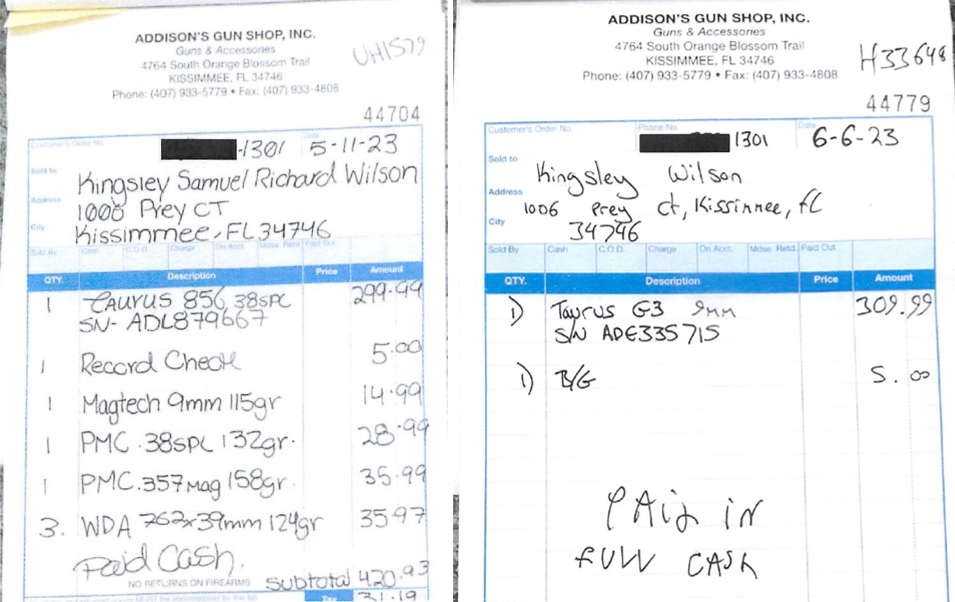
In March 2024, Wilson was sentenced to 3 years and 10 months in prison, and Rodriguez received 2 years and 6 months. By then, 24 of the 140 firearms they purchased had been recovered at crime scenes, including 12 in the Bahamas. The dealers that sold over 100 firearms to Wilson and Rodriguez have not been charged.
One Trafficking Network, Over 1,000 Guns
Ricardo Sune-Girón recruited straw purchasers who bought more than 1,000 firearms from licensed gun dealers across Florida and then transported them to the Dominican Republic and Haiti. Eight firearms traced through the network have been recovered at crime scenes in the Dominican Republic so far.29Plea Agreement, United States v. Sune-Giron, No. 8:24-cr-00514 (M.D. Fla. Dec 12, 2024), at 22, https://www.courtlistener.com/docket/69407007/35/united-states-v-sune-giron/.
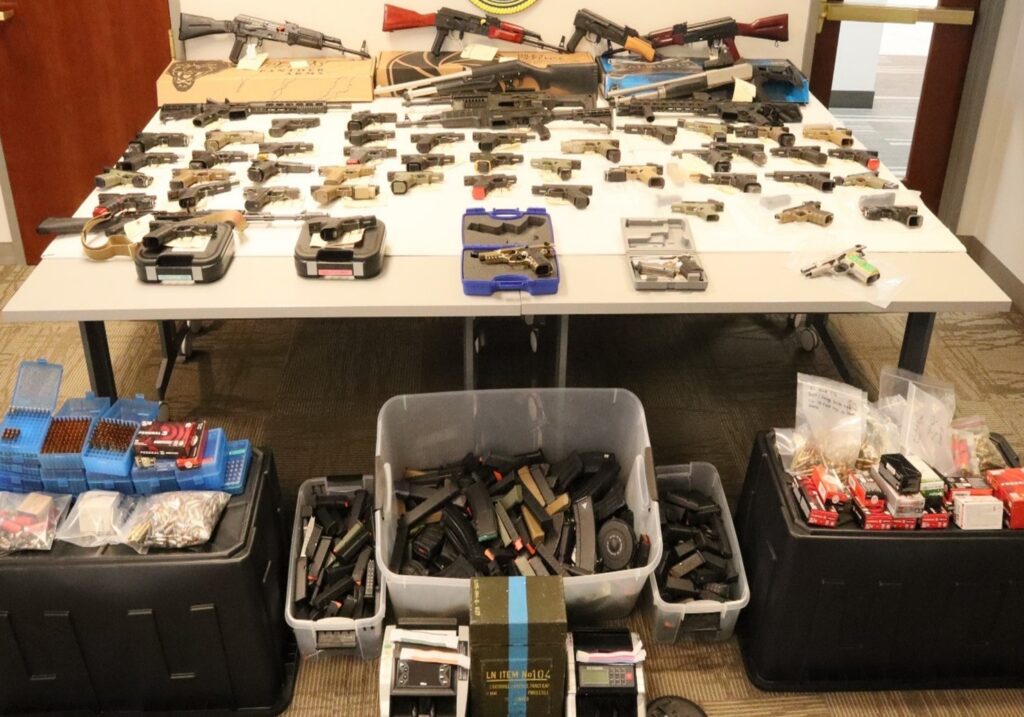
Many of the firearms came from Matthew Easton, who held a federal firearms license as a manufacturer and dealer through MIA Arsenal. Unlike many other licensed firearms dealers fueling Caribbean gun violence, Easton was investigated and charged for his role. Easton was sentenced to 11 years and 8 months in federal prison, among the longest sentences ever imposed on a licensed dealer for firearms trafficking. Between October and December 2023, Easton knowingly supplied more than 100 Glock pistols and AK-47 rifles, plus machine gun conversion devices, to Derick Perez Diaz, despite knowing Perez Diaz was dealing firearms without a license. Perez Diaz resold the weapons to Ernesto Vazquez in Kissimmee, who funneled them onward to Sune-Girón’s network for smuggling to the Dominican Republic, Haiti, and Puerto Rico.
Another member of the trafficking ring, Michael Adrian Nieto, an officer with the St. Cloud Police Department, pleaded guilty to dealing firearms without a license after purchasing at least 58 firearms between June 2022 and September 2024 and supplying them to Vazquez. Nieto knew they were destined for the Dominican Republic, Puerto Rico, and Haiti, and used confidential police databases to provide law enforcement information to Vazquez.30Plea Agreement, United States v. Nieto, No. 6:25-cr-00027 (M.D. Fla. Jan 29, 2025), at 18-28, https://www.courtlistener.com/docket/69589634/4/united-states-v-nieto/.
The network that MIA Arsenal and Nieto fed into was massive. In July 2025, Jonathan Rafael Ortega-Martinez, the operation’s logistics man, pleaded guilty to conspiracy to traffic firearms to the Dominican Republic in a related Tampa case.31Plea Agreement, United States v. Cepeda-Garcia, No. 8:24-cr-00542, (M.D. Fla. July 25, 2025), https://storage.courtlistener.com/recap/gov.uscourts.flmd.435611/gov.uscourts.flmd.435611.105.0.pdf. The factual basis of his plea agreement reveals the scale of the pipeline. One cooperating witness told the ATF that he alone sold approximately 120 firearms in 2023 to a single organizer and was paid roughly $50,000 in cash and Zelle payments.32Id, at 21. Text messages showed the organizer placing weekly, sometimes daily, orders for Glock 19 and Glock 47 pistols.33Id. In one exchange, the organizer texted a photograph of $30,000 in cash.
When the ATF executed search warrants in Kissimmee in April 2024, agents recovered approximately 57 firearms, 30 empty gun boxes, ammunition, $16,000 in cash, and money counters. At a second Orlando-area location, they found 10 more firearms, thousands of rounds of ammunition, and grenades.34Id, at 22.
But apart from MIA Arsenal, the federally licensed dealers who sold nearly 1,000 guns into this pipeline have never been named. The plea agreements identify those stores only as federal firearms licensees within the Middle District of Florida.
Ignored Red Flags with Deadly Consequences
Dozens of firearms ended up at crime scenes in the Caribbean from these three case studies alone. More cases can be found here.
Federal law requires dealers to refuse sales they know, or have reasonable cause to believe, would be illegal. The ATF and NSSF both train dealers to watch for straw-purchase indicators: nervous buyers, bulk purchases of identical firearms, cash purchases, and buyers photographing the guns at the counter for someone else. Many of those indicators were present at these Florida counters, but the stores did not stop selling.