Last month, the Trump administration rescinded the “zero tolerance” policy, which tasked the Bureau of Alcohol, Tobacco, Firearms and Explosives (ATF) with revoking the licenses of gun dealers, or Federal Firearms Licensees (FFLs), who willfully violated federal law and allowed guns to fall into the wrong hands. Under the policy, the ATF cited over 1,000 FFLs for serious violations and revoked more licenses than ever before.
Now, the ATF has posted a notice on its website announcing that FFLs who surrendered their licenses or had them revoked under the “zero tolerance” policy “may reapply” — potentially allowing FFLs to reopen their doors after being cited for transferring firearms to people prohibited from owning them, failing to run background checks on customers, falsifying records, and other violations.
The ATF also published a new administrative action policy indicating that the agency will be much more lenient on FFLs going forward, a move that — despite President Trump’s “tough on crime” pledges — could aid gun traffickers while simultaneously making it harder for police to solve crimes involving firearms.
new atf policies
The ATF’s administrative action policies help guide ATF inspectors and their supervisors in addressing any violations of the Gun Control Act (GCA) that are uncovered during an FFL inspection. But the new policy published by the ATF shows that the agency is poised to once again let repeat offenders off the hook — a reputation it developed before the “zero tolerance” policy was implemented in 2021.
In the previous administrative action policy released in August 2024, the ATF stated that the agency has “zero tolerance for willful violations that put public safety at risk and will take appropriate administrative action,” but all of that language has been removed from the latest version. Instead, license revocations are only “recommended” in certain situations.
While repeat violations over multiple inspections can indicate that an FFL’s violations were willful, the new policy is careful to remind inspectors that “[s]ome violations may be repetitive, yet accidental, and not inconsistent with public safety.” New language also states that the “ATF has the burden of proof in establishing willful GCA violations and not every repeat violation is willful, even where the legal requirement underpinning the violation was known.”
FFLs are required to maintain inventory and transaction records, and without them, the ATF cannot trace crime guns back to their original purchasers. These records are vital. But the new policy appears to downplay record-keeping errors that could hinder the ATF’s firearm tracing capabilities: “Repeat non-willful errors (particularly those involving paperwork) may occur, even by a conscientious licensee. Inadvertent errors in properly completing required forms do not amount to ‘willful’ violations, unless there is evidence that the licensee was at least plainly indifferent towards the licensee’s legal duties.”
These statements mirror remarks made by the National Shooting Sports Foundation (NSSF), which repeatedly claimed that the “zero tolerance” policy shuttered FFLs for “minor clerical errors” — despite evidence of dealers committing serious violations like failing to conduct background checks and transferring firearms to prohibited purchasers. The NSSF later took credit for having the Trump administration rescind the policy.
license revocations
The ATF’s administrative action policies lay out certain violations that could warrant a license revocation. But compared to the previous policy, the new guidance has been edited to raise the bar for revocations and give FFLs more leeway. For example:
- “Failing” to conduct a background check has become “Refusing to comply with the Brady Act’s background check provisions.” The previous guidance also provided steps FFLs should be taking as part of the background check process, but that language has been removed.
- “Failing to respond to a firearms trace request within 24 hours after receipt of request” is now “Refusing to respond to a firearms trace request within 24 hours after receipt of request.”
- “Transferring a firearm knowing or having reasonable cause to believe that the transferee of record is not the actual buyer (i.e., a straw purchase)” is now “Transferring a firearm knowing that the transferee of record is not the actual buyer (i.e., a straw purchase).” Obviously, it will be much more difficult for ATF inspectors to prove that an FFL knew they sold a gun to a straw purchaser, versus when they should have known. This seems to raise the burden on inspection findings from willfulness to criminal intent.
- “Allowing an employee who is a prohibited person to have actual or constructive possession of a firearm” has been changed to “Allowing an employee who is a prohibited person to have possession of a firearm,” meaning the gun must now be under their direct control. This could have major implications for criminal cases involving prohibited persons, including felons and domestic abusers, having access to firearms.
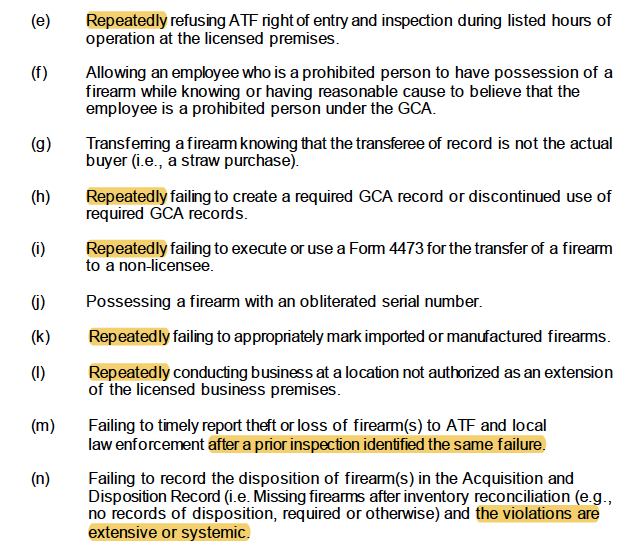
- “Repeatedly” has been added to several violation types, as shown below, without being defined, and additional qualifications have been added to (m) and (n).
downgraded violations
Three violations that were previously considered worthy of license revocation were downgraded. In the new policy document, they are now listed as merely warranting a warning conference, where ATF personnel will meet with the FFL and discuss the violations and their remedies.
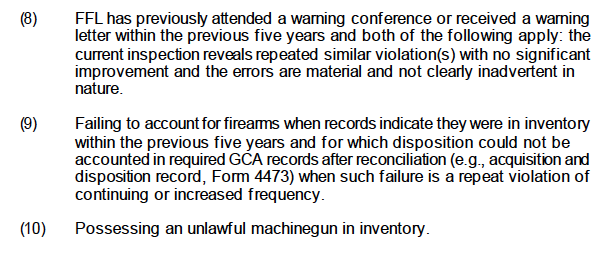
The first provision essentially means that an FFL can continue to rack up violations — even after attending a warning conference or receiving a warning letter and showing “no significant improvement” — and still only face another warning conference.
The same is true for FFLs who repeatedly allow guns to go missing, as noted by the second provision. ATF data shows that FFLs lost 72,776 firearms between 2016 and 2023, and over 20,000 of those firearms went missing in 2022 and 2023 alone. Similarly, FFLs reported that they had 46,072 firearms stolen between 2017 and 2023, and over 11,700 of those firearms were stolen in 2022 and 2023. As the ATF notes, stolen “firearms are at greater risk of rapidly being used in shootings,” and more than half of stolen pistols later recovered and entered into the ATF’s NIBIN system “were used in a shooting event within one year of being reported stolen.“
Finally, it’s a felony — punishable by up to 10 years in prison and a $250,000 fine — for any civilian to possess an unregistered machine gun. But under this new policy, if an FFL keeps an “unlawful machinegun” in their inventory, they’ll receive what amounts to a slap on the wrist.
Examples of the dangerous gun dealers who had their licenses revoked can be found in this report and this prior investigation, raising the question: Are these the kinds of gun dealers people want operating in their communities?