On Friday afternoon, the Bureau of Alcohol, Tobacco, Firearms and Explosives (ATF) published an open letter stating that it would no longer require Americans to apply for and register silencers, short-barreled rifles and shotguns, and other easily concealed weapons as required by the National Firearms Act (NFA) of 1934. Instead, the federal law enforcement agency says it will only “administer the NFA on a voluntary basis” with regard to these deadly items, allowing them to be manufactured and sold like conventional firearms.
As discussed below, the unprecedented move carries out a major priority of the gun industry and will certainly help bolster its sales. The ATF issued its guidance after a federal judge in the Northern District of Texas ruled that certain provisions of the NFA could not be enforced against plaintiffs in a lawsuit challenging that foundational gun law. (President Trump reportedly asked the Department of Justice to not appeal that decision as well.)
But the ATF decided to significantly expand the reach of that ruling and apply it to “all Americans, not just those that were plaintiffs in the litigation,” as ATF Director Robert Cekada noted in a video published Friday afternoon.1ATFHQ, “ATF Director Cekada Addresses New NFA Enforcement Posture,” YouTube, October 9, 2026, https://www.youtube.com/watch?v=I48Jq5KGC_4, at 0:58. He framed the ATF’s maneuvering as “ensuring that we equally disperse fairness with our regulations and policy throughout the United States.”2Ibid, at 1:14.
The Impact on Public Safety
The NFA, which was enacted nearly 100 years ago, requires that anyone interested in buying or building a machine gun, silencer, short-barreled rifle or shotgun, or “any other weapon” (a category used for guns disguised as pens, canes, and umbrellas) first submit an application to the ATF along with their fingerprints, a passport-style photo, and a $200 tax stamp before undergoing an enhanced background check. As the ATF itself notes, Congress enacted the NFA to “curtail, if not prohibit, transactions in NFA firearms…because of their frequent use in crime, particularly the gangland crimes of the era,” such as the St. Valentine’s Day Massacre in Chicago, where gangsters disguised as police officers killed seven rival gangsters using short-barreled Tommy guns and a sawed-off shotgun. Criminals at the time preferred such weapons because they were easy to hide under a coat and unleash on unsuspecting victims.
Similarly, silencers, which make it difficult for bystanders and police to recognize that a gun has been fired and pinpoint the direction of fire, were used in several crimes shortly after being invented in the early 20th century.
Since its enactment, the NFA has helped protect the public from these items, but the danger they pose has not diminished. At least five mass shootings have been committed with short-barreled AR-15s, and silencers have been used in several high-profile shootings — most recently in the assassination of UnitedHealthcare CEO Brian Thompson. More examples can be found here.
Despite the risks these weapons pose to public safety, the gun industry has spent years trying to deregulate silencers and short-barreled firearms, lobbying behind bills like the Hearing Protection Act and for the ATF to receive additional funding to more quickly process NFA applications. Then, in July of last year, the Trump administration and Congress zeroed-out the $200 taxes that had been required to make or purchase silencers, short-barreled rifles and shotguns, and “any other weapons” (AOWs) since 1934. More recently, the Department of Justice and ATF issued several proposals designed to undermine and shortcut the NFA’s vetting process. But now, with its open letter, the ATF appears to be stepping away from its role in enforcing the NFA more broadly.
Creating More Uncertainty
On Friday, the ATF published an FAQ page answering questions about its new “nonenforcement policy” regarding silencers, short-barreled firearms, and AOWs. But the agency noted that people who possess unregistered NFA items could still be prosecuted under state and local laws, creating more uncertainty in an already-tricky legal landscape. Toward the bottom of the page, the ATF also warned the gun industry and people more broadly that “[m]aterial changes in legal or factual circumstances could cause NFA enforcement to resume. For example, Congress could impose a new tax on NFA firearms, the district court’s injunction could be dissolved or overturned, or the Department could rescind the enforcement guidelines.”
If one of those “changes” materializes, the ATF warns that the “NFA treats unregistered firearms as contraband. Individuals who make, possess, transfer, or receive unregistered NFA firearms are subject to felony penalties and forfeitures.” Additionally, “Federal law does not generally permit subsequent registration of unregistered NFA items nor are there provisions that would automatically grandfather unregistered NFA firearms.”
These warnings raise questions about the ATF’s decision to no longer enforce several provisions of the NFA for “all Americans” given the legal jeopardy it might put them in.
The Gun Industry Celebrates
Silencer retailers were quick to celebrate the ATF news. The same day the open letter was published, Silencer Central CEO Brandon Maddox appeared in a YouTube video to announce that his company would soon begin shipping silencers to 30,000 dealers across the country so people can walk into a gun store, purchase them like any conventional firearm, and “walk out with your silencer.”
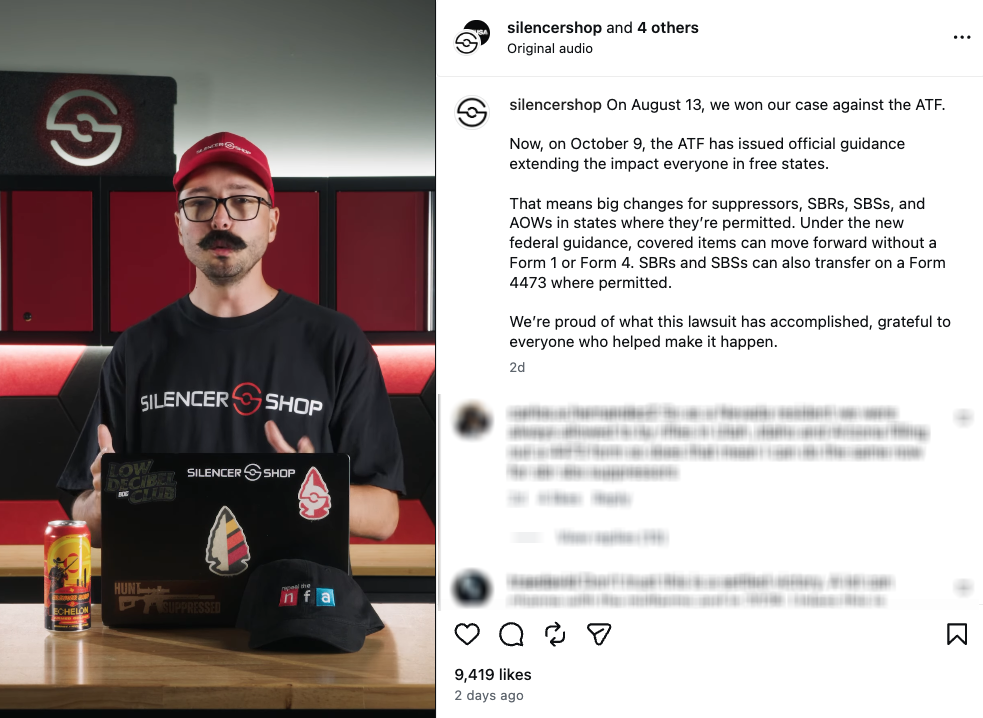
The Silencer Shop, one of the plaintiffs in the Texas case, published a video on Instagram celebrating that the ATF had “extended the impact” of that ruling to cover “everyone in free states.”
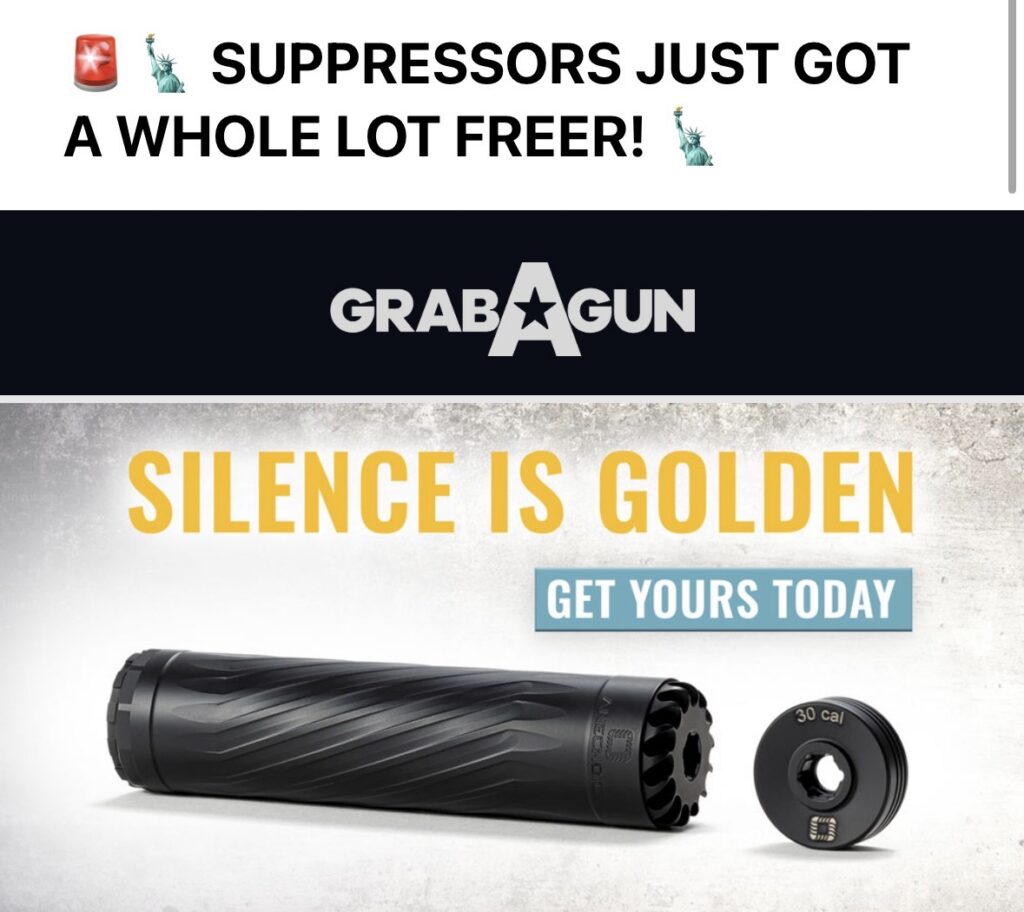
GrabAGun, an online retailer backed by Donald Trump Jr., sent out an email blast announcing that silencers “just got a whole lot freer” and advertising discounts on several models.
According to the ATF, there were roughly 6.9 million silencers registered in the National Firearms Registration and Transfer Record (NFRTR)3The NFRTR includes all NFA weapons registered and possessed by civilians as well as state and local law enforcement, but not the U.S. government. as of September 3, 2026 — a number that has grown by nearly 2.5 million, or 56 percent, since Trump returned to office in January 2025. With the ATF’s new “nonenforcement policy” for the NFA, the number of silencers will likely skyrocket further, but local law enforcement and the public will no longer know the extent of the increase.