At this year’s Shooting, Hunting, Outdoor Trade (SHOT) Show, firearms manufacturers were not just exhibitors — they were an audience for elected officials openly pitching a political strategy: abandon states that effectively regulate guns, consolidate industry power in red states, and use state laws to reshape national firearms policy.
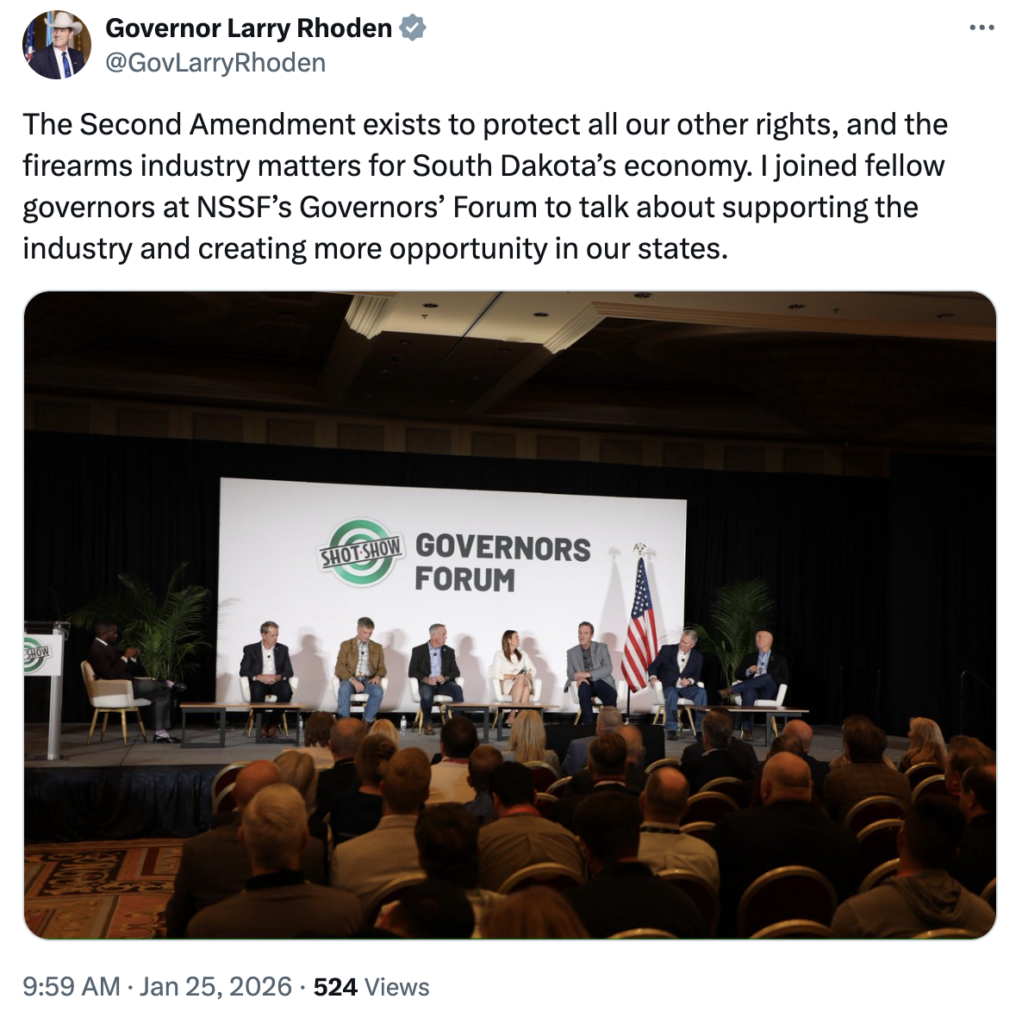
During the fifth annual Governors’ Forum hosted by the National Shooting Sports Foundation (NSSF), the gun industry’s trade association, Republican governors — Jim Pillen of Nebraska, Sarah Huckabee Sanders of Arkansas, Greg Gianforte of Montana, Joe Lombardo of Nevada, Mark Gordon of Wyoming, Larry Rhoden of South Dakota, and Brad Little of Idaho — repeatedly framed the moment as a rare window of opportunity with the White House and Congress under Republican control. The governors urged the gun industry to move quickly and aggressively, not just to expand business, but to permanently weaken gun regulations.
A First for the SHOT Show
NSSF Senior Vice President and General Counsel Larry Keane opened the Governors’ Forum before quickly handing the stage to White House Counsel David Warrington, who founded the National Association for Gun Rights and previously represented Rare Breed Triggers in court. Warrington said that it was the first time that a White House counsel had attended the SHOT Show along with top Department of Justice officials to demonstrate President Trump’s commitment to the Second Amendment.1SHOT Show, “NSSF Hosts 5th Annual Governors’ Forum at SHOT Show 2026,” YouTube, January 26, 2026, https://www.youtube.com/watch?v=5MEBjqFuaUc, at 1:07.
According to Warrington, Trump often remarks that “the people that stuck with him the longest…were the people that support the Second Amendment.”2Ibid at 1:56. He called Trump “a very loyal guy” whose administration has “racked up some wins for the Second Amendment.”3Ibid at 2:15. Those “wins” include several handouts to the gun industry that have opened the floodgates for dangerous weapons.
As Warrington put it, the Trump administration was committed to “keep[ing] this industry growing and vibrant.”4Ibid at 2:28.
Convincing Gun Makers to Move to Red States
Throughout the forum, governors repeatedly urged manufacturers to leave states that regulate firearms and move to states that offer minimal oversight. Governor Huckabee Sanders told attendees that it was best to “operate in a red state.”5Ibid at 42:30. Governor Rhoden said that South Dakota is a “state where we are actively looking to reduce regulations and red tape” and boasted that it is the “second lowest-regulated state in the union” behind Idaho.6Ibid at 28:52.
No moment captured the forum’s tone more starkly than comments from Governor Gianforte, who described his attempts to get gun manufacturers to relocate to Montana from Colorado after that state enacted a law to regulate rapid-fire devices and semi-automatic firearms that accept detachable magazines in 2025. That “decision in a blue state…didn’t make any sense to me,” Gianforte said. “I personally cold-called all the major manufacturers in Colorado, and my message was simple. I said, ‘You want to move back to America?’”7Ibid at 19:51.
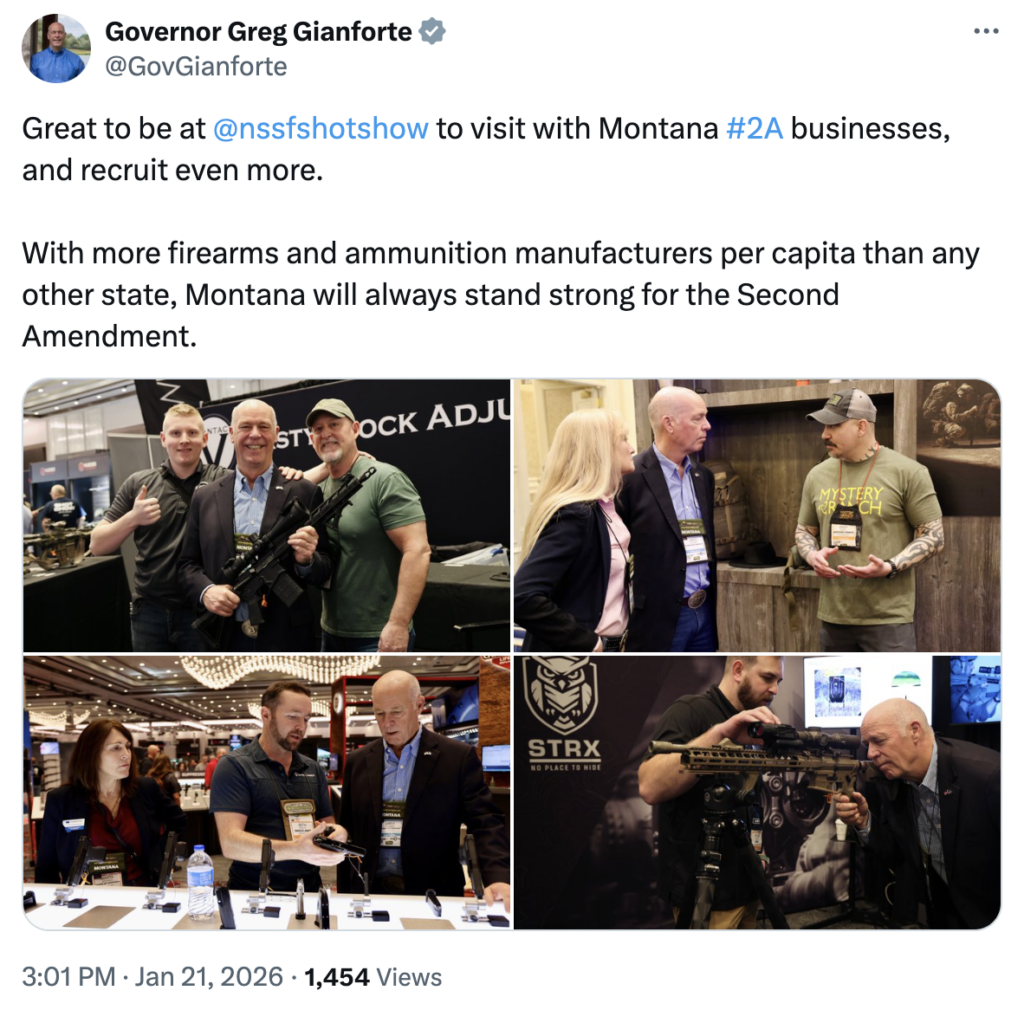
Gianforte also boasted that Montana now has “150 firearms and ammunition manufacturers, more per capita than any other state in the country,” though, he admitted, “we don’t have a lot of people.”8Ibid at 20:40. He credited Montana’s pro-industry banking and permitless-carry laws with attracting gun makers before inviting Governors’ Forum attendees to a party hosted by his state later that day.9Ibid at 21:05.
For its part, the NSSF keeps a tally of gun makers who have fled “restrictive” states, directly linking their exodus to red states to gun laws — not tax breaks and other financial incentives.
States Working to Undo Federal Gun Laws
Throughout the panel, governors described their states as strategic footholds for national change. Governor Rhoden said that state-level deregulation efforts were deliberate attempts to undercut federal law and offered his state’s Firearms Freedom Act as an example.10Ibid at 56:04. That law is an effort to exempt firearms, accessories, and ammunition manufactured in South Dakota from “federal law or federal regulation” as long as those items remain within the state’s borders.
Rhoden said that South Dakota’s recently enacted Senate Bill 2, which deregulates silencers (or sound suppressors), was “designed as a state law to put the pressure on the feds to do the same.”11Ibid at 56:48. Trump’s “One Big Beautiful Bill” removed the $200 taxes previously required to make or purchase silencers, and gun groups are now challenging the federal law regulating silencers in court.
Governor Mark Gordon framed Wyoming’s newly created “stable token” as a way to protect gun commerce and “your Second Amendment rights” if Congress or federal regulators do “something silly”12Ibid at 37:40. — a conspiratorial comment that underscores the lengths his state is willing to go to work around federal regulations. He also referenced a state law, enacted in 2024, that blocks credit card companies from flagging suspicious gun sales.13Ibid at 38:15.
The Industry’s Direct Access
Rhoden also offered a striking example of how political influence operates behind the scenes to benefit the gun industry, describing a call he received from Brandon Maddox, the founder and CEO of Silencer Central, who complained that his customers had to wait seven days for approvals to purchase silencers when the administrations changed. Rhoden said, “Our team got ahold of Attorney General Bondi, and within a couple weeks, I get a letter from Brandon [Maddox] that the issue had been resolved. They removed that.”14Ibid at 17:51.
Rhoden presented this anecdote as a win and revealed just how quickly regulatory barriers can disappear when gun industry leaders have the ear of top government officials.
Later in the forum, Huckabee Sanders reaffirmed the governors’ commitment to prioritize the needs of the firearms industry: “There’s not a person on this stage who isn’t supportive of the industry and who isn’t going to remove a lot of those unnecessary burdens and regulations.” She said the governors would “stand up and be very public in our support because we know what it means. We know what it stands for.”15Ibid at 42:11.
While the governors were quick to pledge their loyalty to the gun industry, they never addressed the fact that all but one of the states represented on the panel — Arkansas, Idaho, Montana, Nevada, South Dakota, and Wyoming — have a gun death rate above the national average. In Montana, Wyoming, and Arkansas, firearm mortality rates exceed 20 deaths per 100,000 people. As governors pledged to strip away “burdens,” deregulate silencers, and accelerate industry growth, the rates at which people in their states die by gunfire went ignored.