A new report by Everytown Law shows evidence that Academy Sports, a large sporting goods retailer with over 300 locations spread across the country, “repeatedly sold firearms to illegal straw purchasers” — people who illegally buy guns for others, often those who are prohibited from owning them — “despite clear warning signs” between 2020 and 2023. The report draws on court records filed in multiple federal prosecutions of gun traffickers.
According to Everytown Law, “20 Academy stores spread across Arkansas, Georgia, North Carolina, and South Carolina sold over 250 guns to individuals whose purchasing patterns and conduct exhibited a range and combination of red flags” recognized by the Bureau of Alcohol, Tobacco, Firearms and Explosives (ATF) as indicators of straw purchasing. Those red flags include a person buying multiple similar firearms over a short period of time, paying in cash, and coordinating with third-party recipients.
The guns allegedly sold by Academy Sports were trafficked through the “Iron Pipeline” into “New York City and surrounding suburbs, Philadelphia, Washington, D.C., New Haven, and Boston. Many of these Academy guns have already been recovered at crime scenes, including in connection with multiple shootings and in the possession of individuals convicted of felonies as well as minors.”
Academy Sports did not respond to requests for comment from the Associated Press. But this is not the first time it has made headlines in relation to straw purchasing. In 2023, Academy Sports agreed to pay $2.5 million to settle three lawsuits accusing the company of ignoring “clear red flags” when it sold guns to a straw purchaser who went on to arm a serial killer. The company did not admit to any wrongdoing in that settlement.
A Closer look at the report
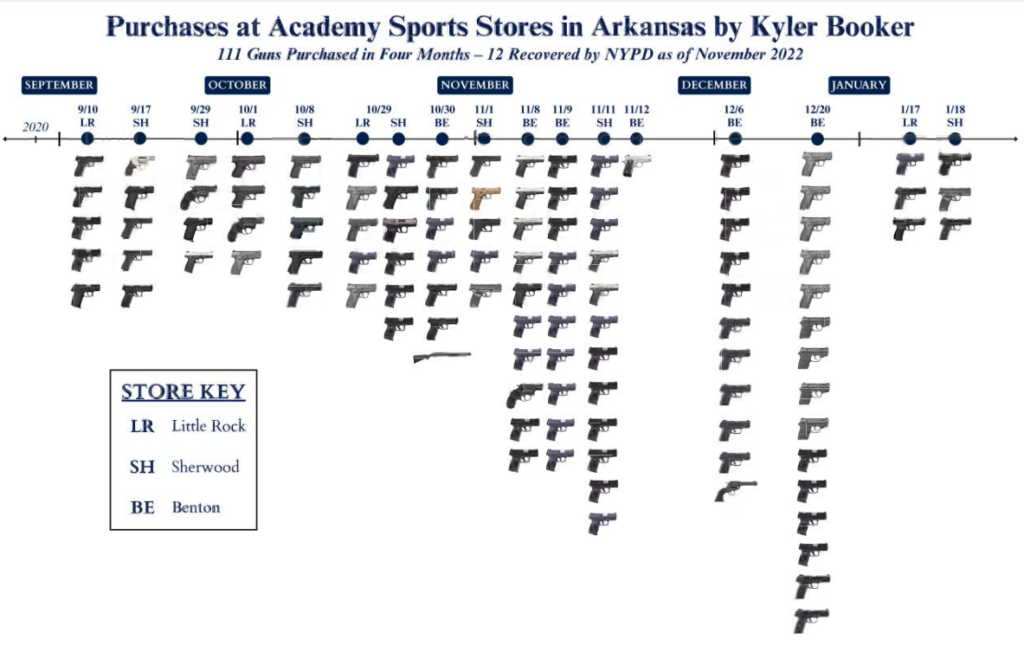
The Everytown Law report lays out several examples of straw purchasers obtaining guns from Academy Sports, such as Kyler Booker, who pleaded guilty to firearms trafficking conspiracy and making false statements to acquire firearms in January 2025. The report notes that Booker purchased 111 firearms from three different Academy Sports locations in Arkansas within roughly four months. He bought 54 of his firearms from a single Academy Sports in Benton, Arkansas, including 15 nearly identical pistols in a single transaction. He paid in cash every time.
Despite these red flags, Academy Sports “did not stop Booker’s straw purchasing, resulting in over 100 guns being diverted to the criminal market. Academy failed to act over many months — and did not cut Booker off until after it appears that law enforcement flagged Booker’s purchases to Academy directly.”
The New York City Police Department has since recovered “at least 12 of the guns sold by Academy to [Booker], including one in the possession of a person with a felony conviction and one in the possession of a minor.”
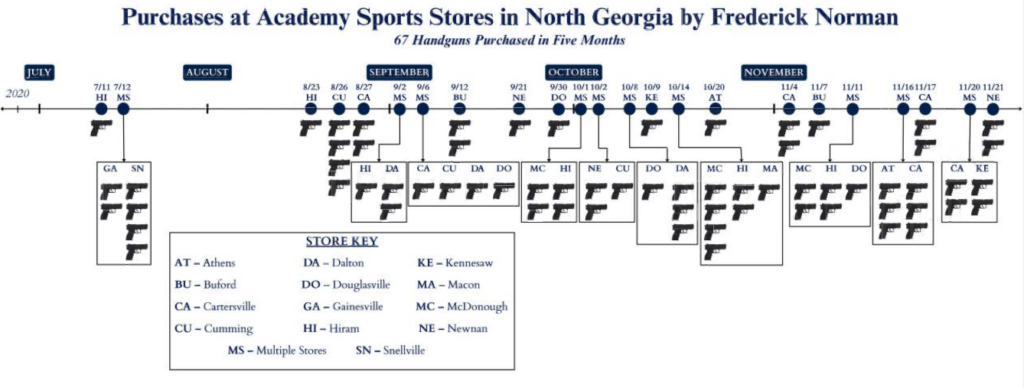
Another example from the report details how four straw purchasers bought 119 handguns from Atlanta-area Academy Sports locations between July and November 2020 as part of an “unprecedented” operation funneling guns to the Northeast. Academy Sports sold 67 of those guns to one straw purchaser, Frederick Norman, in that time frame, as shown by the chart below. Two of the guns sold to Norman were later recovered by the Philadelphia Police Department, and another sold to a co-conspirator was recovered by the NYPD.
Everytown Law asserts that Academy Sports had the ability to stop these sales because it “tracks customers across stores and has information sufficient to recognize when a purchaser is aggregating bulk firearms purchases across stores.” An expert that testified in the lawsuits that led to the $2.5 million settlement said that Academy Sports “had the technological capability to retrieve buyers’ histories but it was not their practice to do so.”
Interview with a Straw Purchaser
Everytown Law also spoke to “an individual who made a large number of illegal straw firearms purchases from Academy stores” to learn more about the company’s practices. The straw purchaser said that “Academy staff who sold him guns remembered him from prior purchases.” But “until his scheme was stopped by ATF intervention, no Academy employee ever refused a sale, asked him why he was purchasing large multiples of the same handgun, or even inquired as to whether he was buying such a large number of guns for himself or for someone else, as the ATF encourages dealers to do.”
Instead, Academy Sports staff would “ask him ‘how many’ of a particular firearm model he wished to purchase” and “volunteered information to him about inventory at other Academy stores when they were not able to fully supply a bulk sale.” Academy staff “would also provide him with other incentives, such as discounts and free ammunition, to encourage additional purchasing,” and at least once “contacted him about new shipments of cheap handgun models.”
The straw purchaser also described how he would speak “to the actual purchaser by phone while at the gun counter, in order to discuss the available inventory” and send “the actual purchaser photos of inventory from inside the store, showing different available colors or models, for instance.” Both are “classic red flags of straw purchasing.”
He even alleged that “an Academy employee, usually a store manager, would generally accompany him and his bulk-purchased firearms to his car after the purchase. He revealed that in several instances, the actual purchaser was waiting in his car in the Academy parking lot, and that he would simply hand over the newly purchased firearms.”
important caveats
The report offers some important caveats: “To be clear, we are not aware of Academy or any of its employees or Board members being prosecuted, civilly sued, or found liable for any of the firearms sales or sales practices discussed in this report, except for the one prior civil lawsuit against Academy [settled in 2023]. Nor do we know what if any action Academy may have taken against employees or managers responsible for the sales discussed herein. While we cannot rule out the possibility that Academy proactively reached out to law enforcement in one or more of the cases detailed in this report…our review of the facts as reflected in publicly available records and other information set forth below does not indicate that it did so. We also are not aware of whether and to what extent Academy stores and employees may have thwarted other straw purchases unrelated to those described in this report.”
Everytown Law also notes that “Academy reported an average of approximately $400 million in annual sales under the ‘firearms’ category over fiscal years 2020-2023, which means that the 250 guns discussed herein represent only a very small percentage of its overall sales. At the same time, the 250+ guns figure captures only those Academy firearms implicated in publicly charged criminal cases, and the actual number of straw sales at Academy stores in recent years could be significantly higher.”
Finally, “many of the straw purchasing prosecutions that are the focus of this report involved purchases from multiple other licensed retailers as well, not just Academy stores; the focus of this report, however, is on Academy, which was the only retailer that was a significant source — and often the largest source — of the straw purchasing across all of the prosecutions that give rise to this report.”
ACADEMY Sports’ Policies
The report raises several questions about Academy Sports’ practices and concludes by asking the company’s management and board to “investigate the transactions discussed in this report, determine what happened and whether and where its policies and procedures may be deficient, and take concrete steps to remedy any issues and mitigate these risks going forward.”
Those proposals include better training for employees to detect straw purchasers, using an internal system to track multiple firearm sales and ATF crime gun trace requests, and disciplining employees who do not comply with the company’s policies or sell guns to straw purchasers.