A new Everytown for Gun Safety Support Fund report has found that four times as many people are shot in mass shootings that involve at least one assault weapon or high-capacity magazine than mass shootings that involve neither gun industry innovation. Additionally, the report notes that all 10 of the highest-casualty mass shootings that have been committed in the United States since 2016 have involved both assault weapons and high-capacity magazines.
The findings, drawn from an analysis of mass shootings perpetrated from 2016 to 2025, provide further evidence that assault weapons and high-capacity magazines, which allow shooters to fire dozens of shots in rapid succession with greater control, maneuverability, and speed than traditional firearms, have a drastic effect on public safety.
The Gun Industry’s Response to Assault Weapons Bans
The report comes as a new assault weapons ban goes into effect in Rhode Island on July 1, 2026. Virginia enacted a similar law scheduled to take effect on the same date.1As of this writing, two state court judges have issued preliminary injunctions under the Virginia state constitution with respect to the Virginia law. Litigation is ongoing. The states joined nine others, and Washington, D.C., in prohibiting the sale of such weapons. Virginia’s law also prohibits the sale of high-capacity magazines that hold over 15 rounds of ammunition; Rhode Island enacted similar legislation regarding magazines that hold over 10 rounds in 2022.
The gun industry’s reaction to those gun safety measures has followed a predictable pattern: flood both states with as many assault weapons and high-capacity magazines as possible before further sales are prohibited. For example, Palmetto State Armory, a company that produces and sells a variety of assault weapons, including AR-15s and AK-47s, repeatedly told customers it had doubled its production and would prioritize orders for Rhode Island and Virginia ahead of July 1. As the company’s director of branding said in a recent video, “When freedom is threatened, we don’t slow down, we step it up. While politicians work to limit rights, we’ll keep building, keep shipping, and keep fighting to maximize freedom.”2Palmetto State Armory, “Virginia Gun Ban Deadline: Here’s What PSA Is Doing About It | Palmetto State Armory,” YouTube, April 21, 2026, https://www.youtube.com/watch?v=ufG7UYaywGo, at 0:30.
Palmetto State Armory also released a video announcing that it had stocked up on long guns and magazines in its brick-and-mortar stores in North and South Carolina, including one “right off” Interstate 95, so if Virginia customers “wanted to drive on down, you can.”
In an Instagram post, another assault weapon manufacturer, Daniel Defense, announced that “Virginia has fallen” and pledged to donate a portion of all AR-10 and AR-15 sales to the Virginia Citizens Defense League (VCDL), a gun group that filed one of the lawsuits challenging Virginia’s new law. Daniel Defense also raised funds for the VCDL by selling patches and stickers featuring AR-style rifles and “Sic Semper Tyrannis” — Virginia’s state motto and a phrase connected to the assassinations of Julius Caesar and President Abraham Lincoln. The implication here is that “tyrannical” lawmakers deserve the same fate.
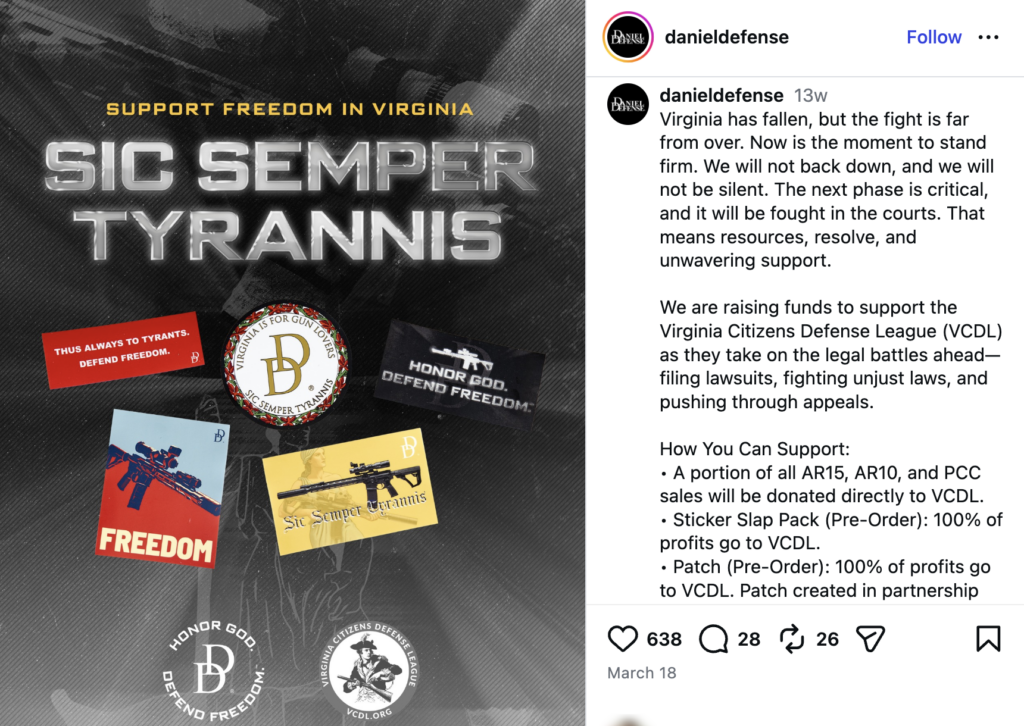
Daniel Defense said the stickers are “an easy way to show support and spread the message of freedom wherever you go,” and the patch “serves as a reminder that liberty endures when citizens remain engaged and committed to protecting it.”
The statements echo those made by the National Shooting Sports Foundation, the gun industry’s trade association, which denounced Virginia’s “unconstitutional law,” claiming it “surrender[s] the freedoms that the Founding Fathers…so wisely fought for and sought to protect to ensure freedom from tyranny.” The group also funded another legal challenge to the law and celebrated one small gun maker’s decision to relocate to Georgia from Virginia.
Finally, Magpul, one of the country’s largest high-capacity magazine manufacturers, donated “roughly $30,000” worth of 30-round AR-15 magazines to gun rights activists who distributed them at a rally outside the Virginia state capitol in March, before such magazines were prohibited. A video from the event shows men handing out the magazines to rallygoers, including a young boy and men with AR-15s and body armor.
More findings from the new report
The gun industry has long resisted laws regulating assault weapons and high-capacity magazines, despite their use in the deadliest mass shootings. The new Everytown report illustrates why such laws are needed.
According to the report:
- Mass shootings “involving assault weapons and/or firearms equipped with high-capacity magazines resulted in twice as many people killed and more than 13 times as many people nonfatally injured.”
- Assault weapons “are used in at least 18 percent of mass shootings but account for 32 percent of all mass-shooting deaths and 77 percent of all mass-shooting injuries.”
- High-capacity magazines “are used in at least 17 percent of mass shootings but account for 33 percent of deaths and 75 percent of injuries.”
- The federal assault weapons ban was allowed to expire in 2004, but had it “remained in place from 2005 through 2022, an estimated 38 public mass shootings could have been prevented.”
- Mass shootings involving assault weapons and high-capacity magazines cost taxpayers, at a minimum, “over $60 million” in law enforcement, legal, and health care expenses, among many others, while generating significant profits for the gun industry.
- The report offers a notable example: The Route 91 Harvest Festival mass shooting in Las Vegas cost an estimated $1 billion in “health care, police response, and lost quality of life” expenses — a figure that matches the revenue four gun makers made in selling assault weapons from 2012 to 2022, according to a House Oversight Committee investigation.
- An NSSF study further highlights the profitability of assault weapons, finding that the owners of ARs and AKs tend to stockpile them and spend over $600 on average accessorizing each rifle.
- Assault weapons “make up a growing share of guns police recover in connection with a crime in cities, with recoveries increasing by 27 percent from 2020 to 2024.”
- ATF data shows that “recoveries of firearms in calibers associated with assault weapons (.223, 5.56mm, 7.62mm) rose from about 18,000 in 2018 to nearly 30,000 in 2023,” reflecting a 64-percent increase.
The report concludes with several recommendations. In addition to reinstating the federal assault weapons ban, which “was effective in preventing gun violence,” the report recommends that states adopt their own assault weapons restrictions to “make themselves and their neighbors safer, providing fewer opportunities for bad actors to acquire these weapons and use them for harm.” Additionally, policies designed “to address firearm trafficking — including dealer licensing and oversight, waiting periods, and purchase limits — can help prevent interstate movement of these weapons.”