In May, the Trump administration agreed to settle three lawsuits involving Rare Breed Triggers, effectively legalizing forced-reset triggers (FRTs) for AR-15s and other semi-automatic firearms, as long as the company agreed “to not develop or design FRTs for use in any handgun,” defined in the agreement as “a firearm whose magazine loads into the trigger-hand grip.” Weeks later, Rare Breed Triggers announced that it had developed FRTs for AK- and MP5-style firearms as well.
But The Smoking Gun found that at least two manufacturers have begun producing FRTs for more conventional handguns. Freedom Finger Triggers, a company that formed earlier this year, has begun selling FRTs for Smith & Wesson M&P and Taurus TX22 pistols. Another company, Trinity Triggers, lists FRTs for Glock and Taurus TX22 pistols for sale on its website in addition to those designed for AR-15s and MP5s.
Collectively, it appears that the Trump administration’s decision to settle with Rare Breed Triggers has opened the floodgate for firearms that fire like machine guns — at a time when communities across the U.S. are reeling from the damage caused by Glock-style pistols turned into machine guns using small, third-party devices called “switches.”
THE FRT LEGAL LANDSCAPE
An FRT is a replacement trigger for a semi-automatic firearm that automatically returns forward, or resets, after being pulled. If a shooter pulls an FRT and holds it back, the gun will continue firing like a machine gun.
The Bureau of Alcohol, Tobacco, Firearms and Explosives (ATF) had previously classified Rare Breed FRTs as machine guns because they allow a shooter to fire “automatically more than one shot…by a single function of the trigger.” Federal law prohibits civilians from owning machine guns manufactured after May 19, 1986.
Rare Breed Triggers challenged the ATF’s ruling in two different lawsuits that were eventually dismissed. Then, the National Association for Gun Rights (NAGR), an extreme gun rights group, filed a separate challenge in the Northern District of Texas, where Judge Reed O’Connor struck down the ATF’s ruling. The Department of Justice had appealed that decision but, after Trump took office, abruptly reversed course and settled with Rare Breed Triggers. (David Warrington, a lawyer who founded NAGR, led the organization’s challenge against the ATF, and represented Rare Breed Triggers in court, now serves as the White House counsel.)
The Trump administration used a similar settlement strategy to deregulate Franklin Armory’s short-barreled, AR-style Reformation in late August.
Freedom finger triggers
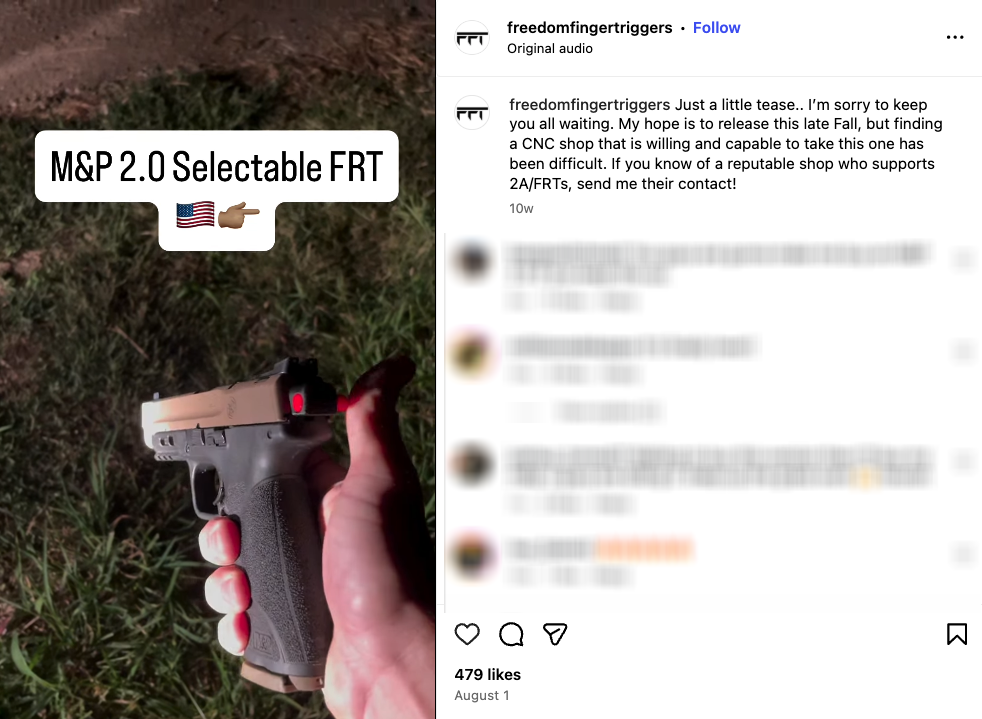
The Freedom Finger Triggers website and Instagram page contain several videos showing people firing dozens of rounds in seconds with FRT-equipped Smith & Wesson and Taurus pistols. According to their product pages, the Smith & Wesson FRT works in M&P M2.0 pistols in 9mm, 10mm, .40, or .45 ACP caliber, and the Taurus FRT works in all .22-caliber TX22 pistols. The company also sells an adapter that allows TX22s to use drum magazines that hold 90 rounds of .22-caliber ammunition.
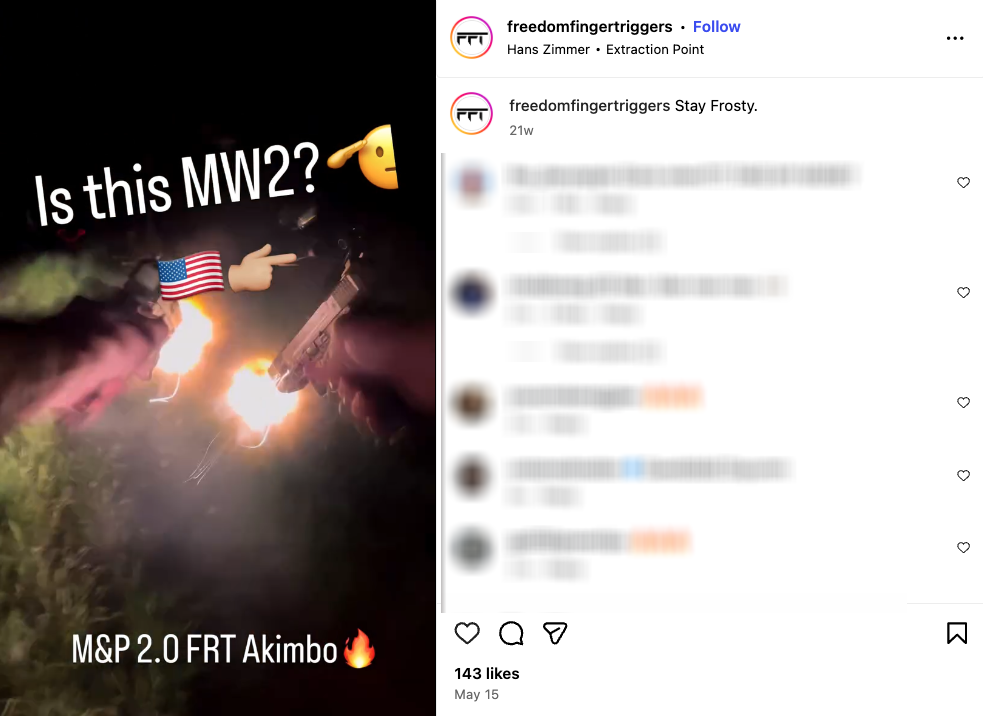
The Freedom Finger website links to two YouTube videos showing viewers how to install the FRTs, a process that takes less than five minutes for each model. While the Taurus FRT replaces a component inside the gun’s trigger mechanism, the Smith & Wesson version snaps onto the back of the gun’s slide and interferes with the trigger bar, much like a Glock switch. But on its website, the company argues that the Smith & Wesson FRT is “not an auto sear!” — another term for switches — because the trigger resets between shots, if ever so slightly.
In a recent YouTube video, 3D firearm printer “Print Shoot Repeat” explained how to maintain pressure on the FRTs to spray bullets: With the Smith & Wesson version, “you can press [the trigger] as hard as you want. It’ll always force the reset” to continue firing. With the Taurus model, you “just keep your finger light on the trigger.”1PSR and Gun Drummer, “Another Insane Pistol FRT | M&P 2.0 FFT,” YouTube, October 5, 2025, https://www.youtube.com/watch?v=AMHArlAMhhg, at 7:37.
The Freedom Finger website points to the recently settled NAGR court case to say that FRTs “are not considered machine guns under federal law.” The company also states that it has sold out of the Smith & Wesson FRT and paused future sales “while we wait for our official ATF classification letter” — implying that the company sold an unknown number before receiving such a letter. According to the company, “While we are fully confident in our design and firmly believe it is a true forced reset trigger, we want the powers that be to be in agreement with us.”
In the meantime, the Taurus FRT is currently available for sale on the Freedom Finger website and through other online retailers — including Donald Trump Jr.’s GrabAGun.
How Will Gun Makers Respond?
For its part, Trinity Triggers of Georgetown, Texas, offers fewer details on its website, suggesting that the company is still in its infancy. Its Glock FRT was “[b]uilt for faster follow-up shots,” while the Taurus FRT is similar to the model offered by Freedom Finger Triggers: It’s designed to drop into the gun, works with any TX22 variant, and “resets the trigger automatically during slide cycling” for rapid firing.
As of this writing, Glock, Smith & Wesson, and Taurus have not made any statements or publicly distanced themselves from these developments.
It is also unclear how the ATF — which stated that its “New Era of Reform” under Trump would be “marked by transparency” — will respond to these innovations. The Trump administration has positioned itself as being “tough on crime,” but the settlement with Rare Breed Triggers has already led to a wider swath of dangerous innovations that will only make shootings significantly deadlier.