Since 1934, federal law has imposed strict registration requirements on rifles and shotguns with barrels shorter than 16 and 18 inches, respectively, because they are easy to conceal under a coat or in a backpack. But last month, the Bureau of Alcohol, Tobacco, Firearms and Explosives (ATF) under President Trump announced that it had reclassified Franklin Armory’s short-barreled, AR-style Reformation and Antithesis as standard “firearms” that are no longer subject to enhanced federal oversight as part of a settlement agreement — reversing the agency’s previous rulings on the weapons and making them easier for civilians to own.
However, in yet another turn, the ATF issued an open letter yesterday stating that Franklin Armory had attempted to market and sell a subsequent version of the Antithesis chambered for 5.56mm NATO ammunition that was indeed a short-barreled rifle subject to National Firearms Act registration requirements.
According to the ATF, “Franklin Armory falsely represented to consumers that these weapons are not ‘short-barreled rifles’ and that they could be transferred without complying with the National Firearms Act. In doing so, Franklin Armory was putting consumers in legal jeopardy because they could be subject to prosecution by any future administration.”
another antithesis

The Antithesis was originally designed with a rifled 14.5-inch barrel that could fire both .410 shotgun shells and .45 Colt cartridges used in revolvers and lever-action rifles. The company asserted that it did not meet the federal definition for a “short-barreled rifle” because it could fire multiple shotgun pellets — and not just “a single projectile” — per trigger pull. But in December 2021, the ATF ruled otherwise, noting that the gun’s barrel rifling actually hindered its effectiveness with shotgun pellets, proving that the gun was instead “designed and made” to fire single projectiles at a time.
Franklin Armory eventually sued the ATF over its classifications, and this past February, a Trump-appointed judge ruled that the agency had overstepped its authority. The Department of Justice had appealed the decision before abruptly changing course in July and entering into a settlement agreement with Franklin Armory. The ATF then reclassified the Antithesis as a standard “firearm” in late August.
In its new open letter, the ATF noted that the “settlement agreement applied to the…Antithesis in the caliber and configuration that had been submitted to ATF.” But on August 29, Franklin Armory submitted another Antithesis to the agency that could fire standard 5.56mm NATO ammunition as well as a prototype cartridge that held multiple shot pellets, shown below. According to the ATF, “Pointing to the July 2025 settlement agreement, Franklin Armory asserted that because its new submission could shoot a multiple-projectile load, it was not a ‘rifle’ under the Gun Control Act or the National Firearms Act.”
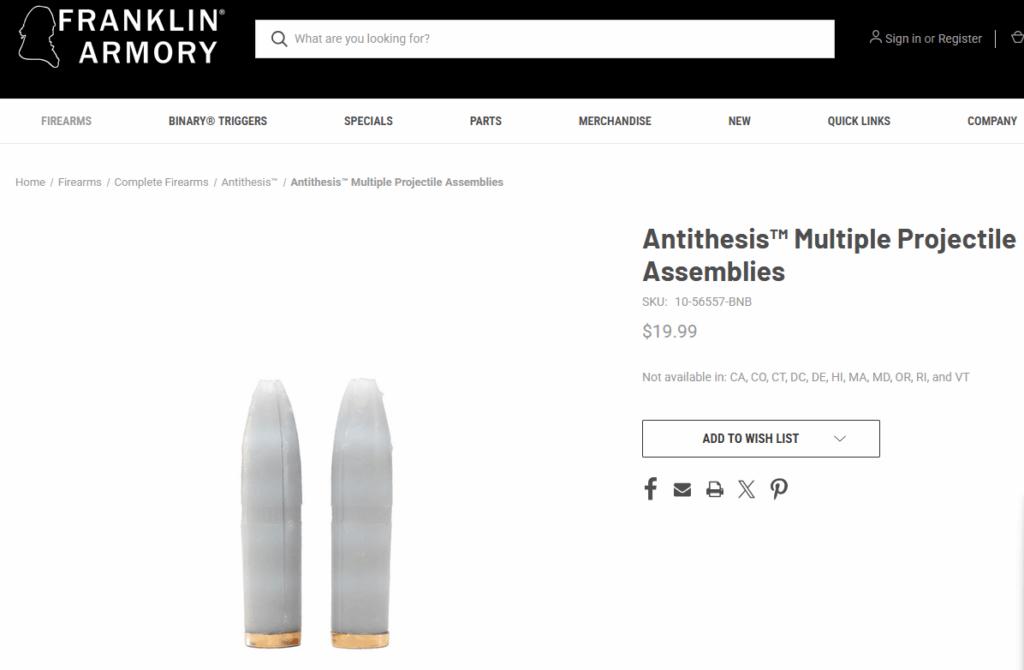
The ATF noted that before it could classify the new Antithesis, “Franklin Armory proceeded to advertise online and sell” three different 5.56mm NATO models with rifled 7.5-, 12-, and 12.5-inch barrels. The agency found that “all three Antithesis-branded firearms are standard AR-type rifles, no different from other short-barreled AR-type rifles sold by other manufacturers,” because they could still fire standard 5.56mm NATO ammunition.
According to the agency, “Franklin Armory’s contemporaneous submission of an exotic 5.56mm ammunition that could be used in any 5.56mm chambered rifle reflects, at most, the design of new ammunition. It says nothing about the design of the rifle Franklin submitted in August — the sole relevant question under the statutory language. That rifle, again, features materially the same design as other standard AR-type rifles except in one respect — its barrel length.”
The ATF held that “there is no material difference between Franklin Armory’s August submission and other short-barreled AR-type rifles on the market — which are classified as short-barreled rifles.” The same could be argued for the earlier .45 Colt/.410 Antithesis prototype as well, but in this case, the “ATF instructed Franklin Armory that it needed to retrieve the weapons it had previously sold.”
A POLITICIZED AGENCY?
Under the Biden administration, gun groups like the National Rifle Association and National Shooting Sports Foundation accused the ATF of being a “politicized” agency doing the bidding of gun violence prevention groups. But the ATF’s open letter, oddly left unsigned, has a more political tone than previous rulings — and several nods to gun rights advocates. For example, the agency stated that it is acting “[w]ith new leadership in place” and “recognizes that Congress and the public are debating whether federal law should subject short-barreled rifles to National Firearm Act controls.”
Such commentary in an official classification or open letter is startling. While gun groups have lobbied Congress to remove provisions of the National Firearms Act — ultimately resulting in lawmakers cutting the taxes required to make and purchase silencers and short-barreled firearms as part of the “One Big Beautiful Bill” — and those same groups are now challenging the foundational law in court, there is not much of a public “debate” surrounding the law’s merits. It has been an effective tool for regulating short-barreled rifles and other dangerous weapons since it was enacted in 1934.
Additionally, the ATF stated, “Among the many objections raised against ATF in the past, one of the most serious is that ATF has a poor history with classifying firearms accurately, transparently, and consistently, depriving manufacturers, dealers, and consumers of the predictability they deserve.”
This is another nod to gun groups and the industry, which have long complained about the ATF issuing private letter rulings and reversing its positions. (The industry claimed that the ATF “reversed course” in regards to arm braces, for example, but a closer look at the agency’s own documents proves otherwise.) It is highly ironic that the ATF emphasized the word “consistently” in this context — after producing two different rulings regarding what is essentially the same gun.